
“Nevertheless it is not a little remarkable that sympathy with the distresses of others should excite tears more freely than our own distress; and this certainly is the case.”
Charles Darwin, The Expression of the Emotions in Man and Animals (1872), chapter VIII
We argued about the number nine for a while before writing this. Nine reasons sounds like nine boxes to tick, and a page of boxes is the last thing someone needs after crying in a meeting because a manager asked, kindly, how the project was going. So here is the promise up front. There are no boxes on this page.
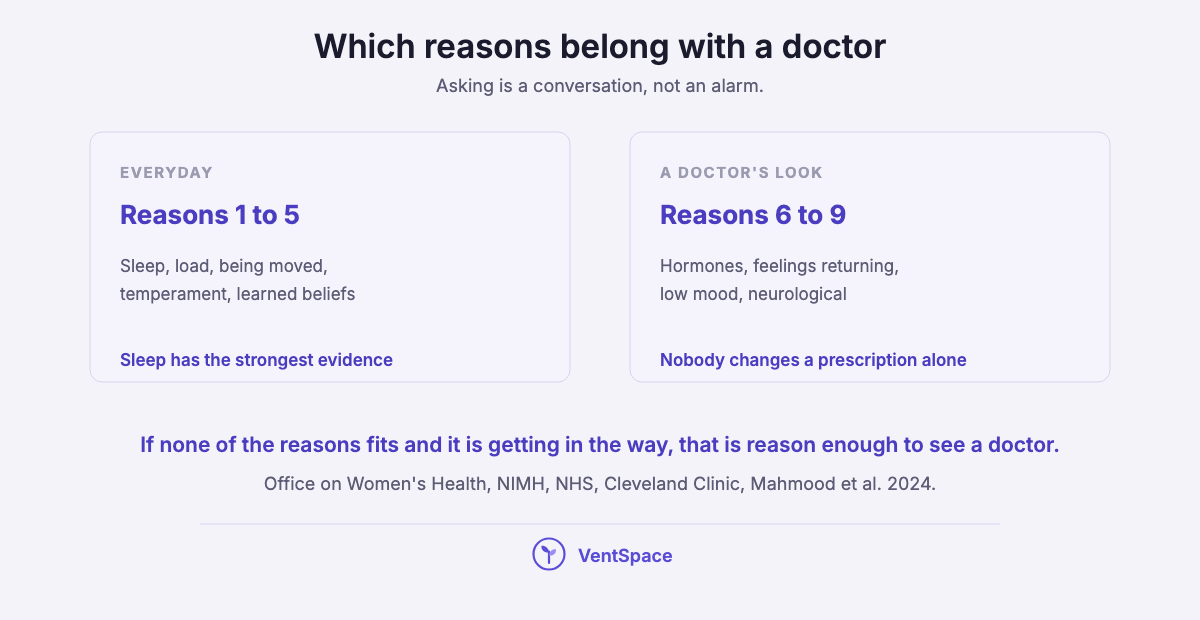
If you are wondering why you cry so easily, the honest answer is that there may be a reason you can name, and that reason does not have to be a flaw. Five of the nine below are everyday ones: sleep, what you are carrying, being moved, temperament and how you learned to see tears. Four are worth a doctor’s look: hormones, feelings coming back after a flat stretch, a low mood that has settled in, and a neurological cause.
You teared up at a dog-food ad on Sunday. You could not get through your friend’s wedding toast. Which of those felt like weakness, and which one was you being moved?
The short version
Easy tears are ordinary. A 2019 review of crying research says adults most often cry in mundane situations, like conflicts, minor frustrations, films and music.
Five reasons are everyday. Sleep, load, being moved, temperament and what you learned about crying.
Four are worth a doctor’s look. Hormones, feelings returning after a flat stretch, a low mood, a neurological cause.
There is no count that tells you which. The page gives you questions instead.
If you’re in crisis or thinking about harming yourself, please contact the 988 Suicide & Crisis Lifeline now (US, call or text 988), or find a line in your country at findahelpline.com. This page is not a substitute for that.
The 9 reasons at a glance
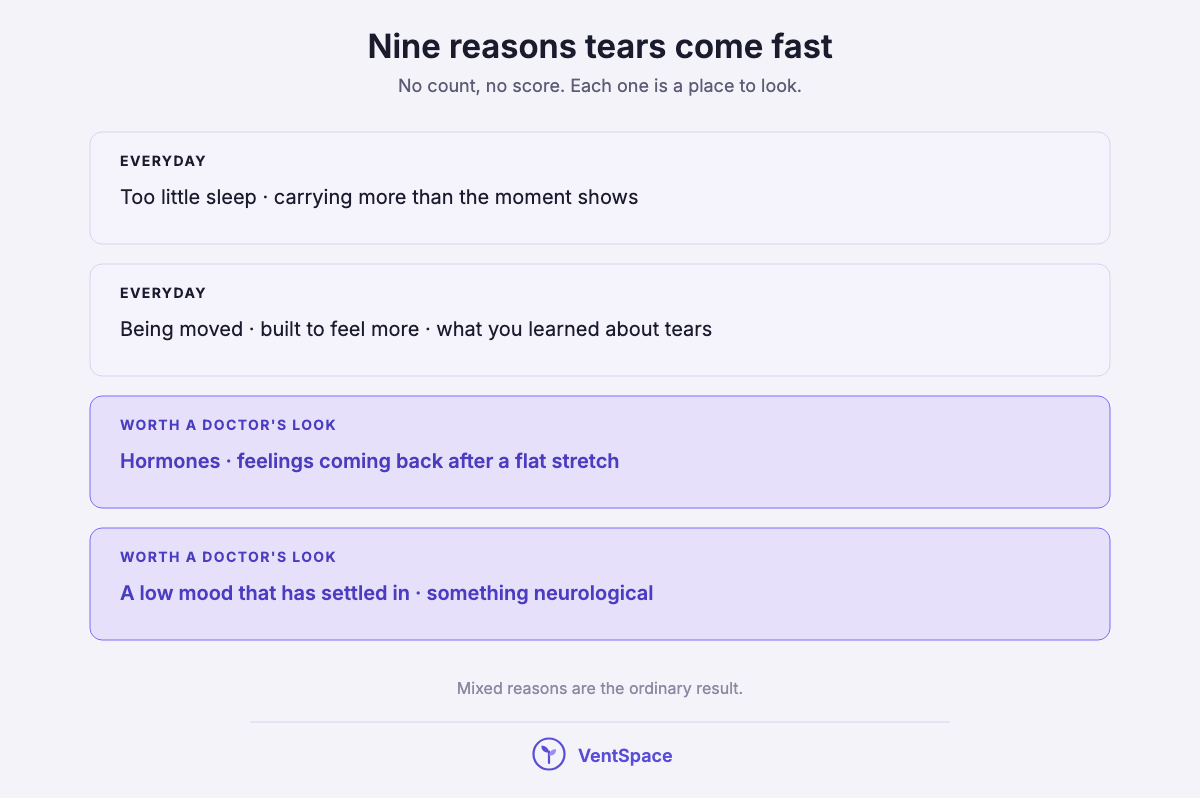
- 1. Too little sleep: mood takes a measurable hit after a short night, and that research is strong.
- 2. Carrying more than the moment shows: the small thing lands on a big pile.
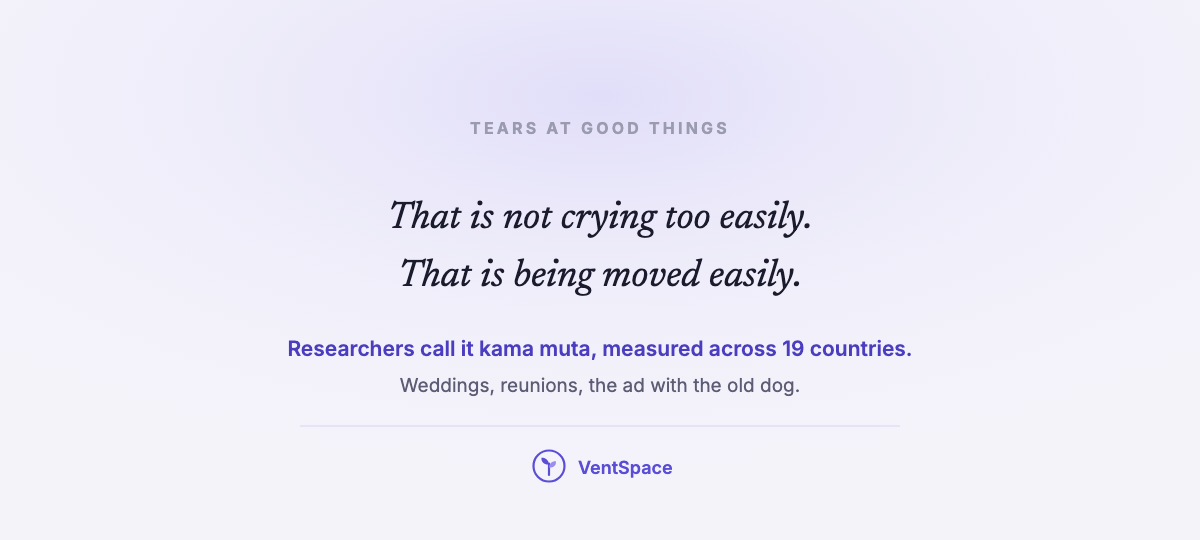
- 3. Being moved, not sad: weddings, reunions, the ad with the old dog.
- 4. Built to feel more: a real, measured difference in sensitivity between people.
- 5. How you learned to see crying: what you believe about tears is linked to how often they come.
- 6. Hormones: the cycle, pregnancy and the weeks after, perimenopause. Worth a doctor’s look.
- 7. Feelings coming back after a flat stretch: both directions get louder at once. Worth a prescriber’s look.
- 8. A low mood that has settled in: worth a doctor’s or therapist’s look.
- 9. Something neurological: crying that does not match how you feel. Worth a doctor’s look.
How we sorted these
Every reason carries two labels, and neither of them is a score. The first is how much evidence sits behind it, written plainly, because a reason backed by a meta-analysis and a reason backed by one study should not look the same on the page. The second is whether it is worth a doctor’s look, and why.
What you will not find is a checklist. Some pages on this question end with a list of signs or a number of times a week that means something is wrong. We left that out on purpose. A page cannot examine you, and a count printed at someone who has just recognized themselves turns a question into a verdict. Is it fair to judge your own tears against a number nobody can source? We did not think so.
Quick Summary
Q: How were these reasons chosen and labeled?
A: Each reason is marked for how much evidence supports it and whether it is worth a doctor’s look. There is no checklist or crying count on the page, because no source supports one and a page cannot assess anyone.
The everyday reasons
These five are everyday reasons, and none of them means anything is wrong with you. They can stack. A short night, a hard week and a sentimental film can land on the same evening.
1. You are running on too little sleep
A short night makes everything land harder, and this is the best-evidenced reason on the page. Pooling 64 studies and 241 effect sizes, a 2021 set of meta-analyses in the journal Sleep found that losing sleep raised negative mood by a moderate amount (g = 0.45) and lowered positive mood by a large one (g = −0.94).
| What it is | Less sleep than you need, for one night or many |
| How it tends to show up | Tears at things you would shrug off after a good night |
| Evidence | Strong for mood: three meta-analyses, 64 studies (Tomaso, Johnson and Nelson, 2021). Crying itself was not measured |
| Worth a doctor’s look? | Only if the sleep problem itself will not shift |
Who this fits: anyone whose tears cluster on the days after a bad night, or in a season of broken sleep.
In practice: check the drink as well as the night. Alcohol is a separate factor, not a sleep finding, but a 2019 review describes a study of 100 female students in which those who had been drinking reported more crying episodes at an emotional film, without feeling more moved by it. One study, so treat it as a hint rather than a rule.
Verdict: check the night before first. It is the cheapest reason to test. Our piece on being tired but wired goes further on sleep that will not come.
2. You are carrying more than the moment shows
Sometimes the tear is not about the email. The 2019 review by Lauren Bylsma, Asmir Gračanin and Ad Vingerhoets notes that adults “most often cry in relatively mundane situations”, and the examples it gives are “conflicts and minor frustrations” alongside films and music. Sometimes the small thing is the last thing on a pile.
| What it is | A load that has built up out of view: work, money, a relationship, a worry you have not said out loud |
| How it tends to show up | Tears at a small correction, a raised voice, a printer jam, a kind question at the wrong moment |
| Evidence | Moderate for the occasions (conflict and frustration are ordinary crying situations). No source we found measures how a load “lowers the threshold”, so we make no such claim |
| Worth a doctor’s look? | Not for the tears. Worth talking to someone if the load is not getting lighter |
Who this fits: the person who cries when someone is gentle with them, or when a minor thing goes wrong at the end of a long week.
In practice: ask what has been sitting on you, not what set it off. What has been on your mind for weeks that you have not had room to feel? If the weight is a death, our piece on grief versus sadness is written for that.
Verdict: the moment may be the doorway, not the room.
3. You are moved, not sad
A lot of easy crying is not sadness at all. Researchers have a name for the warm, teary feeling that can come at a wedding, a reunion or an ad about an old dog. They call it kama muta, “being moved”, and across 19 countries, 15 languages and 3,542 people, a 2019 study in Emotion found it to be “a distinct positive social relational emotion”, commonly accompanied by “moist eyes or tears” and a warm feeling in the chest.
| What it is | Being moved by a sudden moment of closeness, love, kindness or belonging, including between strangers on a screen |
| How it tends to show up | Tears at weddings, graduations, sports wins, commercials, a stranger helping a stranger |
| Evidence | Moderate: a 19-country measurement study (Zickfeld et al., 2019) and a separate Dutch study of 4,916 adults that found four kinds of crying proneness, including sentimental and compassionate tears (Denckla, Fiori and Vingerhoets, 2014) |
| Worth a doctor’s look? | No |
Who this fits: the person who is embarrassed to cry at happy things and has never thought of them as a separate category.
In practice: next time, check the feeling under the tears. Was it loss, or was it warmth? If it was warmth, that is not crying too easily. That is being moved easily, which is a different sentence.
Verdict: not a problem to solve. Possibly one of your better qualities.
4. You are built to feel more
People differ in how strongly they react to the world, and the difference is measurable. A 2018 study in Translational Psychiatry gave a sensitivity questionnaire to 906 adults and found three groups: about 31% highly sensitive, 40% in the middle and 29% low. The authors describe sensitivity as “a continuous and normally distributed trait”, and the highly sensitive group scored higher in emotional reactivity when the researchers tried to lift people’s mood.
| What it is | A stable difference in how strongly you respond to what happens around you |
| How it tends to show up | You have cried easily for as long as you can remember, at good things and hard things alike |
| Evidence | Moderate: one well-sized study (Lionetti et al., 2018), whose cut-off scores for the three groups the authors call preliminary |
| Worth a doctor’s look? | No, unless it has changed recently |
Who this fits: the person for whom this is not new. If tears have always come fast, that is information too.
In practice: notice the word “normally distributed”. There is no clean line between a sensitive person and everyone else, and the largest group in that study sat in the middle. We are not going to hand you a label. Has this always been true of you, or did it start this year?
Verdict: a trait to know about, not a fault to fix. If it is new, look at reasons 6 to 9.
5. How you learned to see crying
What you believe about tears is linked to how often they come. In two online samples of 623 and 781 adults, a 2016 study in Frontiers in Psychology found that people’s attitudes, especially whether they saw crying as healthy and as controllable, helped explain the link between how they relate to other people and how readily they cried.
| What it is | The beliefs you picked up about crying, at home, at school, at work |
| How it tends to show up | Crying feels either safe and fine, or shameful and something to fight, and the fighting can make the moment bigger |
| Evidence | Limited: correlational, self-report, no effect size in the abstract (Millings et al., 2016) |
| Worth a doctor’s look? | No |
Who this fits: anyone who was often told to stop crying as a child, or who was never told it was allowed.
In practice: a few questions worth answering on paper. What did crying mean in the house you grew up in? Who was allowed to cry there? What happens in your body when you try to hold it back?
Verdict: worth knowing because it changes the meaning of the moment, even when it does not change the tears.
Quick Summary
Q: What are the everyday reasons someone cries easily?
A: Too little sleep, a load built up out of view, being moved rather than sad, a naturally higher sensitivity, and beliefs about crying learned early. Sleep has the strongest evidence. None of these means anything is wrong with you.
Insight: a feeling with its own name
The 2019 study of kama muta describes it as “a distinct positive social relational emotion that is evoked by experiencing or observing a sudden intensification of communal sharing”. In plain terms, tears at closeness are their own thing. Zickfeld et al., Emotion, 2019.
The reasons worth a doctor’s look
These four are not more frightening than the first five. They are worth a conversation because a doctor, a nurse or a prescriber can check something you cannot check from a page. Asking is the ordinary move, not the dramatic one.
6. Your hormones are in a different place
Hormonal shifts come up on eight of the nine ranking pages we read on this question, and rightly. The US Office on Women’s Health lists “crying spells” among possible symptoms of premenstrual syndrome and says to talk to a doctor or nurse “if your symptoms bother you or affect your daily life”. NIMH describes the “baby blues” as mild, short-lasting mood changes many women have soon after giving birth, and says changes that are severe or that do not ease may be a sign of postpartum depression. In perimenopause, the Office on Women’s Health says, you may feel more irritable or anxious.
| What it is | Changes linked to the menstrual cycle, pregnancy and the time after birth, or the years before menopause |
| How it tends to show up | Tears that come in a pattern, the same days each month, or a new tendency that began with a pregnancy or in your forties |
| Evidence | Clinically recognized as a symptom pattern (Office on Women’s Health, NIMH). The popular explanation is weaker than it sounds, see below |
| Worth a doctor’s look? | Yes, if it bothers you or affects your days. After a birth, the National Maternal Mental Health Hotline is 1-833-852-6262 (call or text) |
Who this fits: anyone who notices the tears follow a calendar, or who is pregnant, has recently given birth, or is in their forties with other changes.
In practice: two or three cycles of marking the days you cried on a calendar is a useful thing to bring to an appointment. Not a test. A conversation starter.
Verdict: worth a doctor’s or nurse’s look, calmly, especially if it is new.
The hormone story you may have read is not settled. Several of the pages we read say women cry more because of the hormone prolactin. The 2019 review of crying research says that idea “was mainly based on case studies and observations in a certain duck species”, and that a test of it did not bear it out: girls of the same age who did and did not menstruate did not differ in crying. The same review says “somewhat more convincing may be” the idea that testosterone holds tears back. Bylsma, Gračanin and Vingerhoets, Clinical Autonomic Research, 2019.
7. Your feelings are coming back after a flat stretch
If you have felt muted for a while and now cry at everything, that can be the feelings returning, louder in both directions at once. In a 2024 interview study of 20 adults who had tried to come off an antidepressant, published in Health Expectations, researchers described the return of emotion as a “double-edged sword”, with both positive and negative feelings amplified. One participant put it this way:
“I think it was just because I was feeling very neutral before and then it was a bit like up and down. I think in the first few days and weeks it was very emotional. Like I cried a lot.”
Participant P11, Mahmood et al., Health Expectations, 2024
| What it is | A change in how intensely you feel, after a period when feelings were turned down, studied in people changing an antidepressant |
| How it tends to show up | Crying at things that would not have touched you a few months ago, alongside brighter good moments |
| Evidence | Limited: one qualitative study of 20 people, mostly students, which shows this happens and gives no rate (Mahmood et al., 2024). A 2023 systematic review describes antidepressant-related flattening of feeling as dose-dependent and reversible, which is a prescriber’s area |
| Worth a doctor’s look? | Yes, the prescriber, if a medicine has changed. Nobody should stop or change a prescription on their own |
Who this fits: someone who has recently changed or stopped a medicine. The study was of people coming off an antidepressant. We think the same shape may apply when any long flat stretch lifts, but that is our reading, not a finding.
In practice: none of the nine ranking pages we read on this question mentions this reason. It can feel like falling apart when it may be feeling coming back. That is a question for the person who prescribes for you, and it is a fair one to ask. A sentence that works: “Since the change, I’m crying a lot more, and I’d like to talk about whether that’s related.”
Verdict: worth a prescriber’s look. Not a reason to act alone in either direction.
8. A low mood has settled in
Crying more can sit alongside a low mood that has stopped lifting. The NHS lists feeling tearful among the possible signs of depression, and also notes that a low mood often gets better after a few days or weeks. We are not reproducing a list of signs here. Only a doctor or therapist can tell a heavy stretch from something that needs care, and they look alike from the inside.
| What it is | A low mood that is not shifting, where the tears are one part of a heavier picture |
| How it tends to show up | Tears that come with flatness, hopelessness or losing interest in things, rather than with a clear occasion |
| Evidence | Clinically recognized (NHS). Crying on its own is not a diagnosis of anything |
| Worth a doctor’s look? | Yes. NHS advice is to see a doctor if a low mood does not go away, if you are struggling to cope, or if what you are trying is not helping |
Who this fits: someone for whom the tears are not the main thing. The weight underneath is.
In practice: Therapy is one option. For a lot of people it’s the right one. Our guide on whether you need therapy asks one useful question instead of handing you a checklist. If you are thinking about harming yourself, call or text 988 now.
Verdict: worth a doctor’s or therapist’s look, sooner rather than later.
9. Something neurological is involved
Sometimes, crying is not tied to what you feel at all. Cleveland Clinic describes pseudobulbar affect as “a neurological condition that causes outbursts of uncontrolled or inappropriate laughing or crying”. The episodes do not match the person’s mood, and compared with crying in depression they tend to be “more explosive in onset” and “of shorter duration”. It is associated with conditions such as brain injury, stroke, multiple sclerosis, ALS, Parkinson’s disease and dementia.
| What it is | Crying or laughing that comes on suddenly and does not fit the feeling, linked to a condition affecting the brain |
| How it tends to show up | Sudden tears with no matching sadness, sometimes laughter that does not fit either |
| Evidence | Clinically recognized (Cleveland Clinic) |
| Worth a doctor’s look? | Yes. Neurologists, neuropsychologists and psychiatrists are the clinicians who know it |
Who this fits: someone who has a neurological condition or a past head injury, or whose tears feel disconnected from any feeling.
In practice: the useful detail to tell a doctor is the mismatch: “I’m crying, but I’m not sad.”
Verdict: recognized, and worth naming to a doctor if it sounds like you.
Quick Summary
Q: When is crying easily worth seeing a doctor about?
A: When the tears follow a hormonal pattern, started after a medicine change, sit inside a low mood that is not lifting, or do not match what you feel. None of these needs alarm. Each is a conversation a doctor, prescriber or therapist can have with you.
Insight: the mismatch is the clue
Cleveland Clinic separates pseudobulbar affect from depression by its shape: depression involves a persistent sad mood, while the crying in pseudobulbar affect comes in sudden, brief bouts that do not match how the person feels, “more explosive in onset” and “of shorter duration”.
All nine side by side
| Reason | How it tends to show up | Evidence | Worth a doctor’s look? |
|---|---|---|---|
| 1. Too little sleep | Tears after short nights, late in the day | Strong for mood (64 studies) | Only if sleep will not shift |
| 2. Carrying more than the moment shows | Tears at small corrections or kindness | Moderate for the occasions | Talk to someone if the load stays |
| 3. Being moved | Weddings, reunions, ads | Moderate (19-country study) | No |
| 4. Built to feel more | Lifelong, good and hard things alike | Moderate (one study of 906) | No, unless new |
| 5. How you learned to see crying | Shame, fighting the tears | Limited (correlational) | No |
| 6. Hormones | Tears that follow a calendar or a life stage | Recognized symptom pattern | Yes, if it bothers you |
| 7. Feelings coming back | Louder in both directions after a flat stretch | Limited (20 people) | Yes, the prescriber |
| 8. A low mood that has settled | Tears inside flatness or hopelessness | Recognized (NHS) | Yes |
| 9. Something neurological | Sudden tears that do not match the feeling | Recognized (Cleveland Clinic) | Yes |
How do you work out which one is yours?
You work it out by writing down the next few times it happens, not by thinking about it in general. Memory flattens these moments into “I always cry”. A few lines each time gives you something real to look at. Write them the same day, while you still remember what came just before.
- When was it? The time, the day, and how you slept the night before.
- What came just before? The words, the scene, the song. Be specific.
- What was the feeling under the tears? Hurt, warmth, frustration, relief, or nothing you can name. Nothing is an answer too.
- What else has changed lately? A medicine, a cycle, a new baby, a loss, a long gray stretch lifting.
- Is this new? Or has it been true of you for as long as you remember?
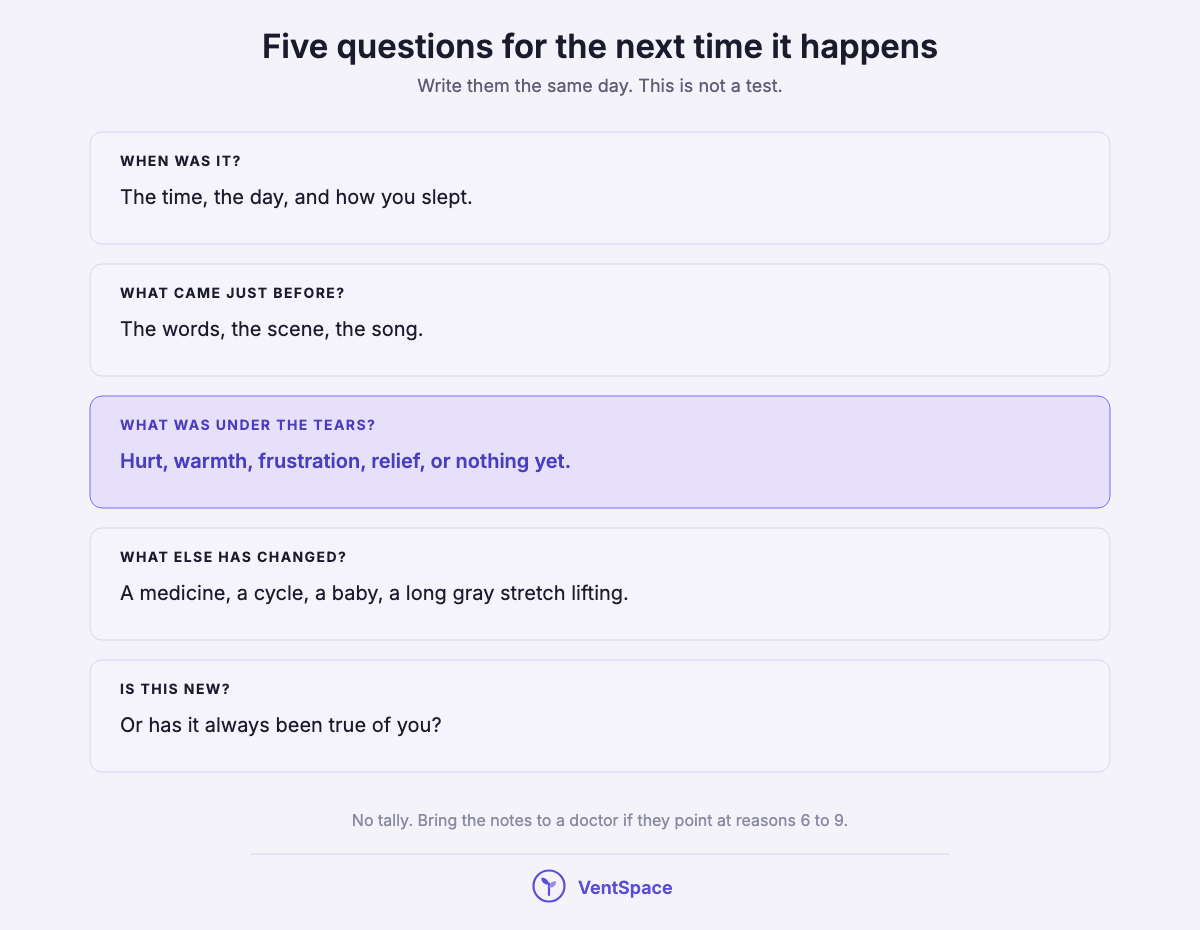
This is not a test, and there is no score. Mixed answers are the ordinary result, because these reasons stack. If the notes point at sleep, change the sleep first. If they point at reasons 6 to 9, take the notes to a doctor. If none of the reasons fits and it is getting in the way of your days, that alone is a good reason to see one.
Where those notes can live. Paper works. If you would rather keep them on your phone, VentSpace is a journaling app that turns what you write into a clear read on your life balance, plus small, doable next steps. It is ours, so read that as a declared interest. It is Android only and free to start as of October 2026, it has no published evidence on outcomes, and it is not therapy. Not on Android, or at a desk? VentSpace Live runs in your browser, free, with nothing to install. The five questions work without it.
Quick Summary
Q: How do I figure out why I cry so easily?
A: Write a few lines each time it happens: when, what came just before, the feeling underneath, what else has changed, and whether it is new. Look for the pattern after several entries. If it points at hormones, medicine, a low mood or a mismatch, take the notes to a doctor.
What can you do when tears come at the wrong moment?
You can give yourself a minute without treating the tear as a fault. Step out if you can, to a hallway or a bathroom. Name what is happening to yourself in plain words, “I’m crying because I’m tired and that was kind”, and come back when you are ready. Saying “give me a second” to the room is allowed.
The first few minutes may feel worse. In a small 2015 lab study of 60 people watching an emotional film, the 28 who cried felt worse straight after, were back to their starting mood by the 20-minute check and felt better than before at 90 minutes. So do not judge the tear by the first ten minutes after it. If what is hardest is that people saw, our piece on public humiliation is about that.
Quick Summary
Q: What should I do if I start crying at work or in public?
A: Step out if you can, name what is happening in plain words, and come back when ready. In one small study, mood dipped right after crying and recovered within about 20 minutes, so the first few minutes are not the whole story.
Insight: what crying may do for the crier
A 2014 review of the research concludes that, “in addition to the importance of socially mediated mechanisms for the mood-enhancing effects of crying, there is converging evidence for the direct, self-soothing effects of crying.” Gračanin, Bylsma and Vingerhoets, Frontiers in Psychology, 2014.
Questions people ask
Is crying easily a sign of depression?
Not on its own. Feeling tearful can be one part of depression, and it can also come from everyday reasons like sleep, load or being moved. If the tears come with a low mood that is not lifting, see a doctor or therapist.
Is it normal to cry every day?
There is no number that makes it normal or not, and we would be wary of any page that gives you one. What matters more is whether it is getting in the way of your work, sleep or relationships, and whether it is new. If it is, that is worth a doctor’s look.
Why do I cry when I’m angry or someone raises their voice?
Conflict and frustration are among the ordinary occasions for adult tears, according to a 2019 review of crying research. Angry tears are still tears. They do not mean you are losing the argument.
Why do I cry at movies and ads?
Sometimes because you are moved rather than sad. Researchers call it kama muta, and tears are one of its common signs. Our explainer on feelings versus emotions covers how a reaction becomes a feeling you can name.
Do women cry more than men?
On average, yes. The 2019 review puts it at about four to five times a month for adult women and none to one for adult men. That is an average, not a rule about anyone. The popular prolactin explanation is not established, and the review suggests a role for testosterone may be more convincing.
Is crying good for you?
The evidence is mixed in an interesting way. Lab studies find mood dips right after crying, and one small study found it recovered and ended better within 90 minutes. Claims that tears flush out stress hormones are not something we could trace to a source.
Two things to take with you
Look for a reason before you accept a verdict. Sleep, a load, being moved, temperament and what you learned about tears can each explain easy crying, and none of them is a defect. Four reasons are worth a doctor’s look, and asking is the ordinary move.
Nobody can tell you how long a reason lasts. A short night can change by tomorrow. Hormones keep their own calendar. A low mood or a medicine question needs someone in the room with you. What you can do this week is write down the next three times it happens.
What was under the last one?
About this article

Written by
Sai Subramaniam
Founder, VentSpace
I write these guides because I have been where you are. I am working through my own hard seasons, and I share the things that actually helped me, so that anyone going through it has a steady companion close by instead of facing it alone. VentSpace is the app I built for exactly that: a journaling app that turns what you write into a clear read on your life balance, plus small, doable next steps toward feeling more like yourself.
This writing is honest and every claim is sourced, and it is not a substitute for professional care. If you are struggling, reaching out to a professional is a strong move, not a failure.
Explore VentSpaceTry VentSpace LiveHow this one was checked. Every factual claim traces to a named source, and the source is printed next to the claim rather than kept in a footnote. Quotes are pinned to the work they come from, with the year, the letter or the chapter where one exists. Where a widely repeated claim could not be traced, it was left out and the omission recorded. Where a figure is contested, both sides are printed.
No affiliate links, no paid placements, and nobody paid to appear here. Where we mention our own app, we say that it is ours, we state its limits, and we never position it as a substitute for care.
Reviewed: October 2026. Prices, platforms and product availability move quickly, and anything we could not verify at the time of writing is marked as unverified rather than turned into a number.
Corrections. If something here is wrong, we would rather know. Corrections are made in place, with a note saying what changed.