
“This constant change can cause both gains and drops in organic Search traffic.”
Google Search Central, Google Search’s core updates (page updated 10 December 2025)
Last updated: 29 October 2026. New entries go into the Latest section at the end, newest first.
**Since May 2020, Google has added page experience and Core Web Vitals to ranking, built SpamBrain into link spam updates, ran a separate helpful content system and then folded it into core ranking, wrote three new spam policies, switched off FAQ and HowTo rich results, and put two AI surfaces, AI Overviews and AI Mode, on top of the results page.
Every change on this page has a date, and Google published nearly all of them. The Google Search Status Dashboard is the record of announced ranking updates from November 2021 onward. Before that, and for anything that isn’t a ranking update, the record is the Search Central blog, Google’s documentation and its product blog. So when you see a drop, you can date it against the changes that matter without leaning on volatility charts.
This page is the summary, one year at a time from 2020 to October 2026, with what each change means for a site owner today. After the timeline there’s a short guide to reading a traffic drop against it, one table of what stopped being true, and a Latest section that grows as Google ships.
How we know
Sources: the Google Search Status Dashboard (ranking history, read 29 October 2026), Search Central blog posts and documentation, Google’s product blog and web.dev. Each row names its source.
Third-party numbers appear only with their method and sample: Ahrefs (300,000 keywords), SparkToro (a Similarweb clickstream panel), SE Ranking (100,000 keywords), Zyppy (80,959 titles). Each carries its date.
The limit: the dashboard lists announced updates only, and its history starts in November 2021. Google also makes smaller changes it doesn’t announce, so a drop with no matching entry is unexplained, not disproven.
Two rows rest on secondary reporting (the num=100 change and the October 2026 rank tracker problem) and say so.
Quick Digest
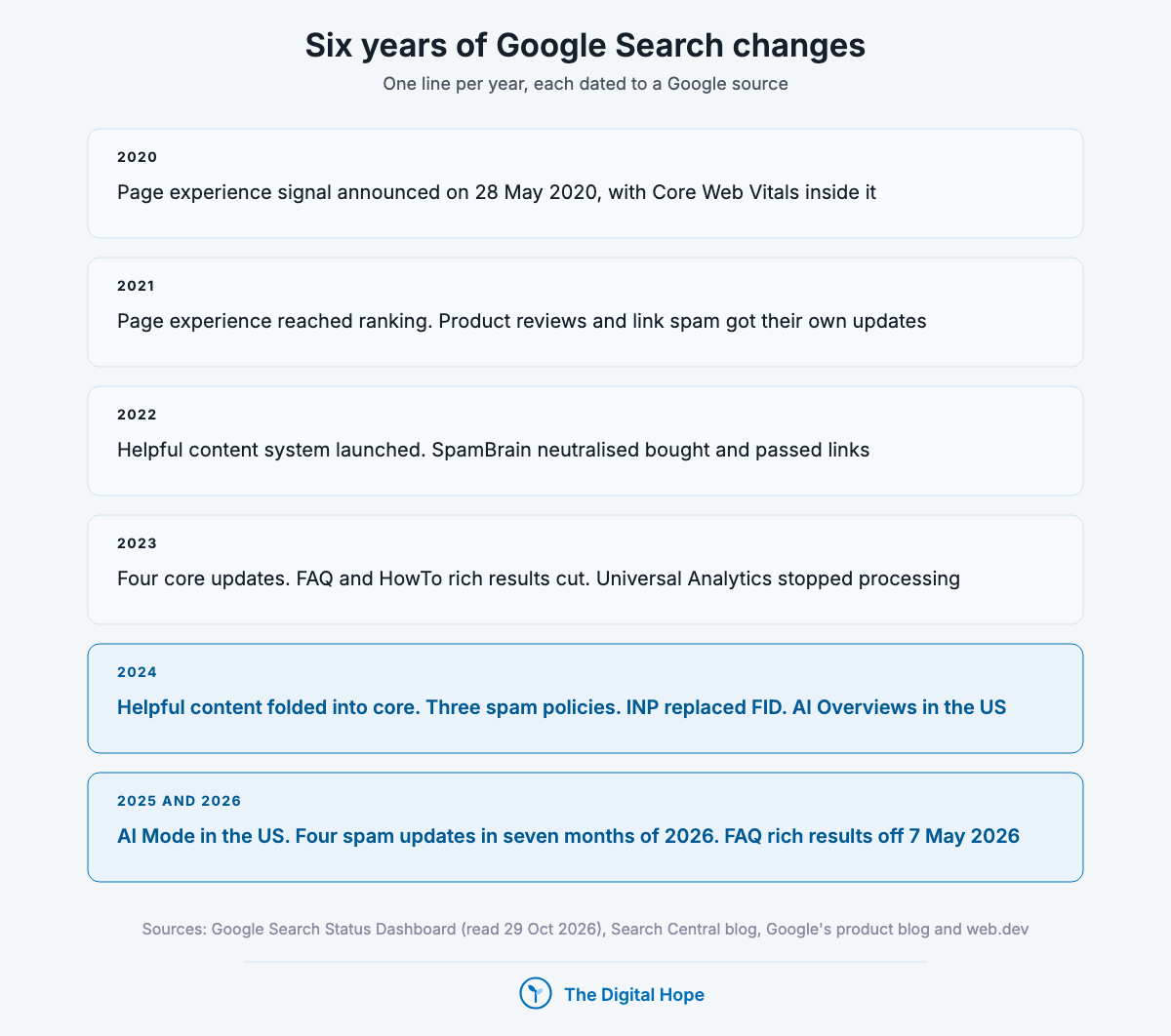
– 2020: Google announced the page experience signal, with Core Web Vitals inside it.
– 2021: page experience reached ranking, product reviews and link spam got their own updates, and titles started being rewritten.
– 2022: the helpful content system and SpamBrain link neutralisation arrived. The URL Parameters tool went.
– 2023: four core updates, FAQ and HowTo rich results cut, Universal Analytics stopped processing.
– 2024: helpful content folded into core, three spam policies, INP replaced FID, AI Overviews reached all US users.
– 2025 and 2026: AI Mode, three core updates a year, four spam updates in seven months of 2026, and FAQ rich results switched off on 7 May 2026.
2020: Google announced page experience as a ranking signal
“The ranking changes described in this post will not happen before next year.”
Google Search Central blog, Evaluating page experience for a better web (28 May 2020)
2020 was the year Google said speed and stability would count, and gave a year’s notice. On 28 May 2020 the Search Central blog announced a page experience signal that combined the new Core Web Vitals (loading, responsiveness and visual stability) with signals Google already used: mobile-friendliness, HTTPS and the intrusive interstitials guideline. The same post said AMP would no longer be required for Top Stories on mobile, and promised at least six months’ notice before anything rolled out.
| Date | Change | What it means for you today | Source |
|---|---|---|---|
| 28 May 2020 | Page experience signal announced: Core Web Vitals plus mobile-friendliness, HTTPS and interstitials. Google said page experience matters most when several pages have similar content | Core Web Vitals are still part of ranking, as a tie-breaker between comparable pages, not a way past better content | Search Central blog, 28 May 2020 |
| 28 May 2020 | AMP no longer required for Top Stories eligibility, from the page experience rollout | No reason to keep an AMP build for news visibility alone | Search Central blog, 28 May 2020 |
| November 2020 | Google published the timing post for bringing page experience to Search | The rollout itself started in mid-June 2021 (below) | Search Central blog, November 2020 |
Google also ran core updates in 2020. They sit outside the dashboard’s history, which starts in November 2021, so this page doesn’t date them.
Notice first, ranking later.
2021: page experience reached ranking, and reviews and links got their own updates
“This update is going out today and only involves English language reviews for now.”
Google Search Central blog, April 2021 product reviews update (8 April 2021)
2021 is when Google started naming updates after the content type they targeted. Product reviews got their own update in April, link spam got one in July, and page experience became a live ranking input over the summer. The year ended with the first entries on what became the Search Status Dashboard.
| Date | Change | What it means for you today | Source |
|---|---|---|---|
| 8 Apr 2021 | Product reviews update: favours reviews backed by in-depth research over thin pages that summarise several products. English only at launch | Review content needs first-hand testing, measurements and comparisons. Since November 2023 it moves with core updates (2023, below) | Search Central blog, 8 Apr 2021 |
| 19 Apr 2021 | Search Console added a Page Experience report and a Performance filter for pages with good page experience | Field data for Core Web Vitals is still read in Search Console | Search Central blog, 19 Apr 2021 |
| Mid-June to end of August 2021 | Page experience ranking rolled out for mobile results, starting in mid-June and complete by the end of August | Desktop followed in February 2022. Mobile and desktop are both covered now | Search Central blog, 19 Apr 2021 (updated 15 Jun 2021) |
| 26 Jul 2021 | Link spam update, rolled out over two weeks across multiple languages. Affiliate links should carry rel=”sponsored” | Qualify paid, sponsored and affiliate links. Unqualified ones are the kind Google sets out to nullify | Search Central blog, 26 Jul 2021 |
| August 2021 | Google changed how it generates title links, drawing on the title element, H1, anchor text and other page text | Your title tag is a suggestion. Zyppy’s 2022 study found 61.6% of 80,959 titles rewritten (historical data) | Title links documentation |
| 3 Nov 2021 | November 2021 spam update, 8 days 1 hour. The earliest entry on the Status Dashboard | The dashboard is the record from here on | Status Dashboard |
| 17 Nov 2021 | November 2021 core update, 13 days | Status Dashboard | |
| 1 Dec 2021 | December 2021 product reviews update, 20 days | Status Dashboard |
The link spam rule is the one that still bites. If you run affiliate content, sponsored posts or guest posts, a missing rel value is the cheapest fix on the site. The on-page SEO guide covers titles and the rest of the page itself.
Name the link, or lose it.
Quick Summary
Q: What were the main Google updates in 2020 and 2021?
A: Google announced the page experience signal with Core Web Vitals on 28 May 2020 and rolled it out to mobile results from mid-June to the end of August 2021. 2021 also brought the first product reviews update (8 April), a link spam update (26 July), the title link change (August), and the first Status Dashboard entries in November.
2022: helpful content arrived, and SpamBrain went after links
“Ranking may change as spammy links are neutralized and any credit passed by these unnatural links are lost.”
Google Search Central blog, December 2022 link spam update (14 December 2022)
2022 split quality from spam. The helpful content system launched as a site-wide signal against content made mainly to rank, and the December link spam update used SpamBrain to neutralise bought and passed links rather than penalise them. Google ran two core updates, in May and September.
| Date | Change | What it means for you today | Source |
|---|---|---|---|
| 22 Feb 2022 | Page experience update for desktop, 9 days | Page experience now covers desktop results too | Status Dashboard |
| 23 Mar 2022 | First of the 2022 product reviews updates. The series ran to 8 Nov 2023 and was later renamed reviews updates | None listed since November 2023 | Status Dashboard |
| 28 Mar 2022 | URL Parameters tool deprecation announced, removed a month later. Google said only about 1% of configurations were useful for crawling | Handle parameter URLs with canonicals and internal linking | Search Central blog, 28 Mar 2022 |
| May and Sep 2022 | Two core updates | Status Dashboard | |
| 25 Aug 2022 | First helpful content update. A second followed in December 2022 | The system still runs, inside core ranking since March 2024 | Status Dashboard |
| 14 Dec 2022 | Link spam update using SpamBrain, 29 days | Paid link credit can vanish with no manual action. The spend stays spent | Search Central blog, 14 Dec 2022 |
If you buy links, this is the year the maths changed. A link that’s neutralised doesn’t trigger a penalty you can appeal. It just stops counting, and the backlink guide covers what earns links instead.
2023: four core updates, and the rich results and tools people relied on started going
“We recommend waiting at least a full week after a core update completes before analyzing your site in Search Console.”
Google Search Central, Google Search’s core updates (updated 10 December 2025)
2023 was the busiest year for core updates and the year Google started removing features. It ran four core updates (March, August, October and November), the last named helpful content update, the last reviews update, and one spam update in October. FAQ and HowTo rich results were cut back, and two measurement tools went.
| Date | Change | What it means for you today | Source |
|---|---|---|---|
| Mar, Aug, Oct and Nov 2023 | Four core updates | Status Dashboard | |
| 1 Jul 2023 | Universal Analytics stopped processing data. All access ended on 1 Jul 2024 | Any year-on-year view across July 2023 compares two different tools | Analytics Help |
| 8 Aug and 13 Sep 2023 | FAQ rich results limited to well-known government and health sites. HowTo rich results removed | Superseded in 2026, when FAQ results went for everyone | Search Central blog, 8 Aug 2023 |
| 14 Sep 2023 | Last named helpful content update | No separate helpful content update has run since | Status Dashboard |
| 8 Nov 2023 | Last reviews update listed | Reviews content now moves with core updates | Status Dashboard |
| 1 Dec 2023 | Mobile-Friendly Test, its API and Search Console’s Mobile Usability report retired. Google pointed to Lighthouse | Mobile usability still counts. Test it in Lighthouse | Search Central blog, 19 Apr 2023 |
Four core updates in a year meant a site could be mid-recovery from one when the next began. That’s still the right way to read 2025 and 2026. If you’re judging a 2023 drop, find which of the four rollout windows it sits in before you compare anything.
2024: helpful content folded into core, and three spam policies landed
“In March 2024, it evolved and became part of our core ranking systems.”
Google Search Central, on the helpful content system, listed under “Retired systems”
March 2024 reset the quality rules. The March 2024 core update ran 45 days, the longest core rollout listed, and Google said results showed 45% less low-quality, unoriginal content, by its own measure. The helpful content system stopped being separate. The same day, Google added three spam policies.
| Date | Change | What it means for you today | Source |
|---|---|---|---|
| 5 Mar 2024 | March 2024 core update, 45 days. Helpful content became part of core ranking | Helpfulness is assessed inside every core update now. There’s nothing separate to wait for | Google blog, 5 Mar 2024 |
| 5 Mar 2024 | Three spam policies: scaled content abuse, expired domain abuse and site reputation abuse (enforced from 5 May 2024) | Pages made at scale to rank are the risk, whether people, AI or both wrote them | Spam policies |
| 12 Mar 2024 | INP replaced FID as a Core Web Vital. Good means under 200 ms at the 75th percentile | Report INP, not FID | web.dev, 12 Mar 2024 |
| 14 May 2024 | AI Overviews rolled out to everyone in the US | In Ahrefs’ 300,000-keyword data, an Overview was associated with about 58% lower position-one CTR (Dec 2025 vs Dec 2023, desktop). That’s correlation, not proof of cause | Google blog, 14 May 2024 |
| 1 Jul 2024 | All Universal Analytics access ended | Export anything you still need from older reports elsewhere | Analytics Help |
| 19 Nov 2024 | Site reputation abuse clarified: the host’s oversight doesn’t make third-party content compliant | Partner pages placed to borrow a host’s rankings are covered even with a co-writing deal | Search Central blog, 19 Nov 2024 |
| Aug, Nov and Dec 2024 | Three more core updates. December’s ran 6 days 4 hours, the shortest core rollout listed. Spam updates in March, June and December | Status Dashboard |
The condition that decides your risk is how the pages were made, not who made them. If you publish programmatic or AI-assisted pages, the scaled content policy is the one to read. If you host partner content, it’s site reputation abuse.
Quick Summary
Q: What changed in Google Search in 2024?
A: The helpful content system became part of core ranking with the 45-day March 2024 core update, three spam policies were added on 5 March (scaled content, expired domain and site reputation abuse), INP replaced FID on 12 March, and AI Overviews reached all US users on 14 May 2024.
Insight
“Expired domain abuse is where an expired domain name is purchased and repurposed primarily to manipulate search rankings.”
Google Search Central, Spam policies for Google web search (updated 28 August 2026)
2025: AI Mode, and a reporting break that looked like a ranking drop
“There are no additional requirements to appear in AI Overviews or AI Mode, nor other special optimizations necessary.”
Google Search Central, AI features and your website (updated 10 December 2025)
2025 added a second AI surface and broke a scoreboard. AI Mode reached all US users on 20 May 2025. Google ran three core updates (13 March, 30 June and 11 December) and one spam update from 26 August that took 26 days. In September, a change to how Google served results moved Search Console numbers without moving rankings.
| Date | Change | What it means for you today | Source |
|---|---|---|---|
| 13 Mar, 30 Jun and 11 Dec 2025 | Three core updates | Three a year is the recent norm | Status Dashboard |
| 20 May 2025 | AI Mode rolled out to everyone in the US | SparkToro’s Similarweb data put AI Mode at 0.34% of US Google searches in January to April 2026 | Google blog, 20 May 2025 |
| 26 Aug 2025 | August 2025 spam update, 26 days | Status Dashboard | |
| Mid-September 2025 | The num=100 results parameter stopped working. Many sites saw desktop impressions fall and average position rise in Search Console (secondary reporting, Search Engine Roundtable) | Annotate September 2025 in every report. Fewer impressions that month isn’t lost ranking | Secondary |
| 10 Dec 2025 | Core updates documentation updated: wait a full week after a rollout completes, recovery “could take several months”, deleting content is “a last resort” | The current recovery guidance. Read it before cutting pages | Core updates |
AI Overviews and AI Mode aren’t ranking updates, and there’s no AI markup to add. Google’s AI features page says so directly. What they change is how many clicks a ranking earns, and how much that matters depends on how many of your own queries show an Overview, which how AI is changing SEO covers in depth.
If you report impressions to a client or a board, flag the September 2025 num=100 break before anyone reads it as a ranking loss.
Annotate September 2025.
2026 so far: spam updates sped up, and FAQ rich results switched off
“[O]ptimizing for generative AI search is optimizing for the search experience, and thus still SEO.”
Google Search Central, AI optimization guide (updated 10 July 2026)
2026 is the fastest spam year on the record. Google ran four spam updates between March and September, against one in all of 2025, plus core updates on 27 March (12 days) and 21 May (11 days 21 hours). FAQ rich results stopped appearing for every site on 7 May 2026.
| Date | Change | What it means for you today | Source |
|---|---|---|---|
| 5 Feb 2026 | February 2026 Discover update, 21 days | Discover can move on its own schedule. Check it apart from Search | Status Dashboard |
| 24 Mar 2026 | March 2026 spam update, 19 hours 30 minutes, the shortest spam rollout listed | Status Dashboard | |
| 27 Mar and 21 May 2026 | Two core updates, 12 days and 11 days 21 hours | Status Dashboard | |
| 7 May 2026 | FAQ rich results no longer shown in Google Search for any site. The documentation was removed on 15 Jun 2026 | FAQ markup earns no rich result. Keep an FAQ section only if readers need it | Documentation updates, 8 May and 15 Jun 2026 |
| 19 May 2026 | Google said AI Mode had passed one billion monthly users (self-reported, “monthly users” undefined) | Users and share of searches are different measures. Neither tells you your clicks | Google blog, 19 May 2026 |
| 3 Jun to 31 Aug 2026 | Search Console’s generative AI report rolled out worldwide: impressions only, no clicks, no queries | You can see AI visibility, not AI traffic. AI Overview and AI Mode clicks sit inside “Web” | Search Central blog, June 2026 |
| 24 Jun and 18 Aug 2026 | Spam updates. In SE Ranking’s 100,000-keyword data, a top-10 URL was about 1.8 times as likely to leave the top 100 during the August update as in a quiet week | Spam updates move more than spam sites. Check your top pages after each one | Status Dashboard, SE Ranking (Aug 2026) |
| 10 Jul 2026 | AI optimization guide updated: llms.txt, content chunking and special schema listed as unnecessary | No AI file or markup gets you in. Indexed, snippet-eligible pages worth citing do | AI optimization guide |
| 28 Aug 2026 | Spam policies page updated. It lists 16 policies, and the section is now headed “site reputation policy” | Re-read it before planning partner content or bulk pages | Spam policies |
| 22 Sep 2026 | Page experience page updated: “Core Web Vitals are used by our ranking systems”, but “There is no single signal” | Fix Core Web Vitals for users. Don’t expect a pass alone to lift rankings | Page experience |
If you track only one area this year, track the spam policies. Four spam updates in seven months is the fastest-moving part of the timeline.
Quick Summary
Q: What Google updates happened in 2026?
A: By October 2026 Google had run two core updates (27 March and 21 May), four spam updates (24 March, 24 June, 18 August and 24 September) and a Discover update (5 February). FAQ rich results stopped showing on 7 May 2026, and Search Console’s AI report reached all sites by 31 August.
How to read a traffic drop against this timeline
“[T]here’s no guarantee that changes you make to your website will result in noticeable impact in search results.”
Google Search Central, Google Search’s core updates (updated 10 December 2025)
A date match is a lead, not a diagnosis. Google’s own guide to traffic drops lists six causes: algorithmic updates, technical issues, security issues, spam issues, seasonality and changing interests, and site moves. An update is one of six.
1. Match the date. Put Search Console’s Performance report beside the Status Dashboard. If the break doesn’t sit inside a rollout window, write “unconfirmed”.
2. Split clicks from impressions. If both fell, look at the six causes. If only clicks fell and the queries now show an AI Overview, the results page may be answering the query.
3. Rule out a measurement break. July 2023 (Universal Analytics), September 2025 (num=100) and October 2026 (rank trackers) all look like ranking changes and aren’t.
4. Wait, then act. At least a full week after the rollout completes, then judge site-wide quality, and set a review date months out. Don’t change pages during the rollout unless the drop has a technical cause you can see, such as a stray noindex or a broken redirect.
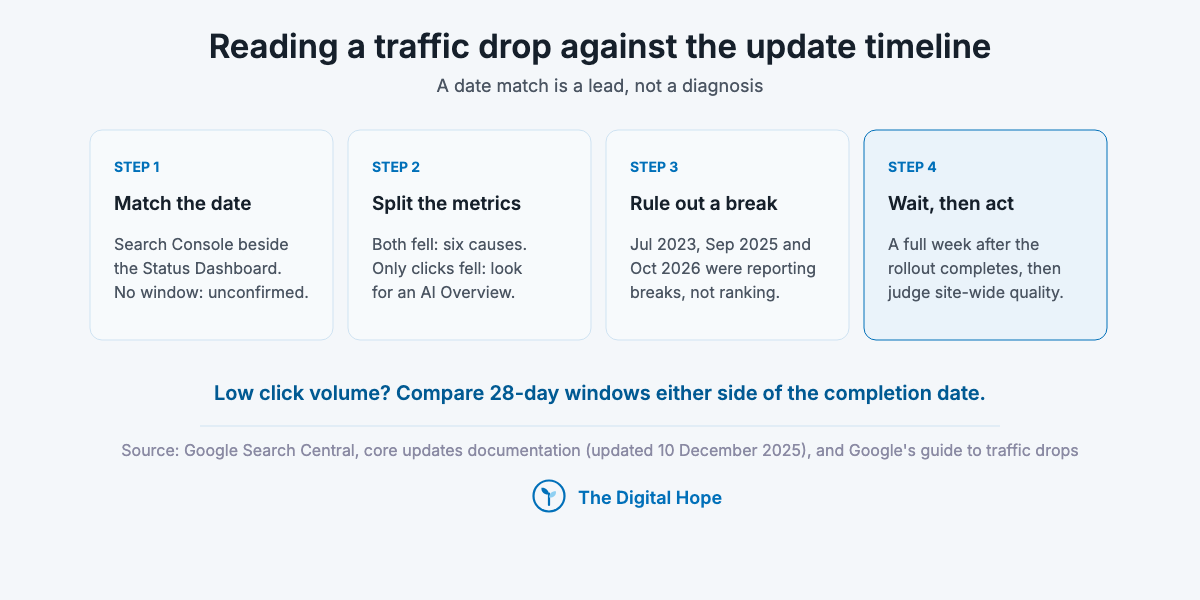
The condition that decides how you compare is volume. With thousands of clicks a day, a week-over-week comparison across a rollout is readable. With a few hundred a week, compare 28-day windows either side of the completion date. When you act, the SEO audit checklist sets the order of checks, and the website optimization guide covers the technical rows.
Date first, theory second.
What stopped being true
| What | When it stopped | Primary source |
|---|---|---|
| AMP required for Top Stories | Page experience rollout, mid-June to Aug 2021 | Search Central blog, 28 May 2020 |
| Setting parameter handling in Search Console’s URL Parameters tool | Announced 28 Mar 2022, removed a month later | Search Central blog, 28 Mar 2022 |
| Universal Analytics as the reporting source | Processing stopped 1 Jul 2023, access ended 1 Jul 2024 | Analytics Help |
| HowTo rich results | 13 Sep 2023 | Search Central blog, 8 Aug 2023 |
| Mobile-Friendly Test and the Mobile Usability report | 1 Dec 2023 | Search Central blog, 19 Apr 2023 |
| A separate helpful content update to recover in | Folded into core ranking, 5 Mar 2024 | Helpful content documentation |
| FID as a Core Web Vital | Replaced by INP, 12 Mar 2024 | web.dev, 12 Mar 2024 |
| Reviews updates as their own release | None listed after 8 Nov 2023 | Status Dashboard |
| FAQ rich results | Limited Aug 2023, off for every site 7 May 2026 | Documentation updates, 2026 |
FAQ
How often does Google update its algorithm?
Google announced about three core updates a year from 2022 to October 2026, by count from its Search Status Dashboard: 2 in 2022, 4 in 2023, 4 in 2024, 3 in 2025 and 2 so far in 2026. Spam updates, link spam included, number 11 over the same period. Google also makes smaller changes it doesn’t announce.
Is the Helpful Content Update still a thing?
No. The helpful content system became part of core ranking in March 2024, and the last named helpful content update began on 14 September 2023. Helpfulness is assessed through core updates now.
How long does a Google core update take to roll out?
Core rollouts on the dashboard ran from 6 days 4 hours (December 2024) to 45 days (March 2024). Google recommends waiting at least a full week after a rollout completes before analysing your site.
Can you recover from a core update?
Sometimes, and slowly. Google says it could take several months for its systems to register site-wide improvements, and that there’s no guarantee changes will show a noticeable effect.
Are Core Web Vitals still a ranking factor?
Google’s page experience page, updated 22 September 2026, says Core Web Vitals “are used by our ranking systems” but that there’s no single page experience signal. Google’s 28 May 2020 announcement said page experience matters more when several pages have similar content.
Are AI Overviews an algorithm update?
No. AI Overviews (all US users from 14 May 2024) and AI Mode (all US users from 20 May 2025) are search features, not dashboard ranking updates. Google says there are no special requirements to appear in them.
Latest
New Google Search news goes here, newest first, each with its date, its source and what it means for you. Older items move into their year above once the year closes.
October 2026 · Rank trackers report “poisoned” Google results. Several tracking vendors said some of the Google results they collected were inaccurate, and Ahrefs put the share at 5% to 20% depending on the data provider (vendor statements, secondary reporting).
What it means: when you see a sudden tracker swing, check it against Search Console before you report it.
15 October 2026 · Google-Extended documentation updated. Google’s crawler documentation says Google-Extended governs Gemini training and grounding and doesn’t affect inclusion in Google Search.
What it means: if you block it, you stay in Google Search. Snippet controls are what limit AI features.
1 October 2026 · Generative AI content guidance updated. Google asks publishers to fact-check AI output and to label AI-generated product images with IPTC metadata.
What it means: AI-assisted pages are allowed. Unreviewed pages at volume are the risk.
24 September 2026 · September 2026 spam update. It ran 13 days 16 hours, the fourth spam update of the year.
What it means: if pages fell inside that rollout window, read the spam policies against them before you look anywhere else.
To follow what’s next, Google’s documentation updates page and the Status Dashboard are the two sources this section is built from.
In a nutshell
Every major change since 2020 has a date and a Google source. Page experience (2020 to 2021), helpful content and SpamBrain (2022), the 2023 feature removals, the March 2024 reset and the AI surfaces of 2024 and 2025 all line up with a published record. This page doesn’t apply when the cause is a migration, a tracking change or seasonality, which is why the measurement breaks are in the timeline.
Give it months, and judge it a full update cycle later. Google says recovery after a core update can take several months and isn’t guaranteed. Set the review date accordingly.
About this article

Written by
Sai Subramaniam
SEO, GEO and Paid Ads Manager · 8+ years in growth marketing
I have run SEO, paid media and ABM for B2B AI companies, consumer apps and live-entertainment brands, from a solo operator at an AI infrastructure company to a team of 20 recovering a million-visitor site after a Google update. I write these guides from that work, and every number in them carries its source.
See my portfolioConnect on LinkedInHow this one was checked. Every number traces to a named source with its dataset and period, and every platform feature, policy or limit cites the platform’s own documentation with the date it was verified. Where the author’s own results appear, they are labelled as one account’s results, with the budget and context, not as a rule.
No affiliate links and no paid placements. Tools are named because they are what practitioners use, not because anyone paid to appear here.
Reviewed: October 2026. Ad platforms and search features change every few months; anything we could not verify at the time of writing is marked as unverified rather than turned into a number.
Corrections. If something here is wrong or has changed since, we would rather know. Corrections are made in place, with a note saying what changed.