

Almost everything written under this heading is trying to make us feel better, and almost none of it works.
That is not a complaint about the sentiment. It is a description of a mismatch. What can help most, in the first weeks and for a long time after, is not consolation but accuracy, a sentence that matches the inside of the week rather than improving on it. Consolation asks us to accept something. Accuracy asks nothing, and is the only one of the two that can be received on a bad afternoon.
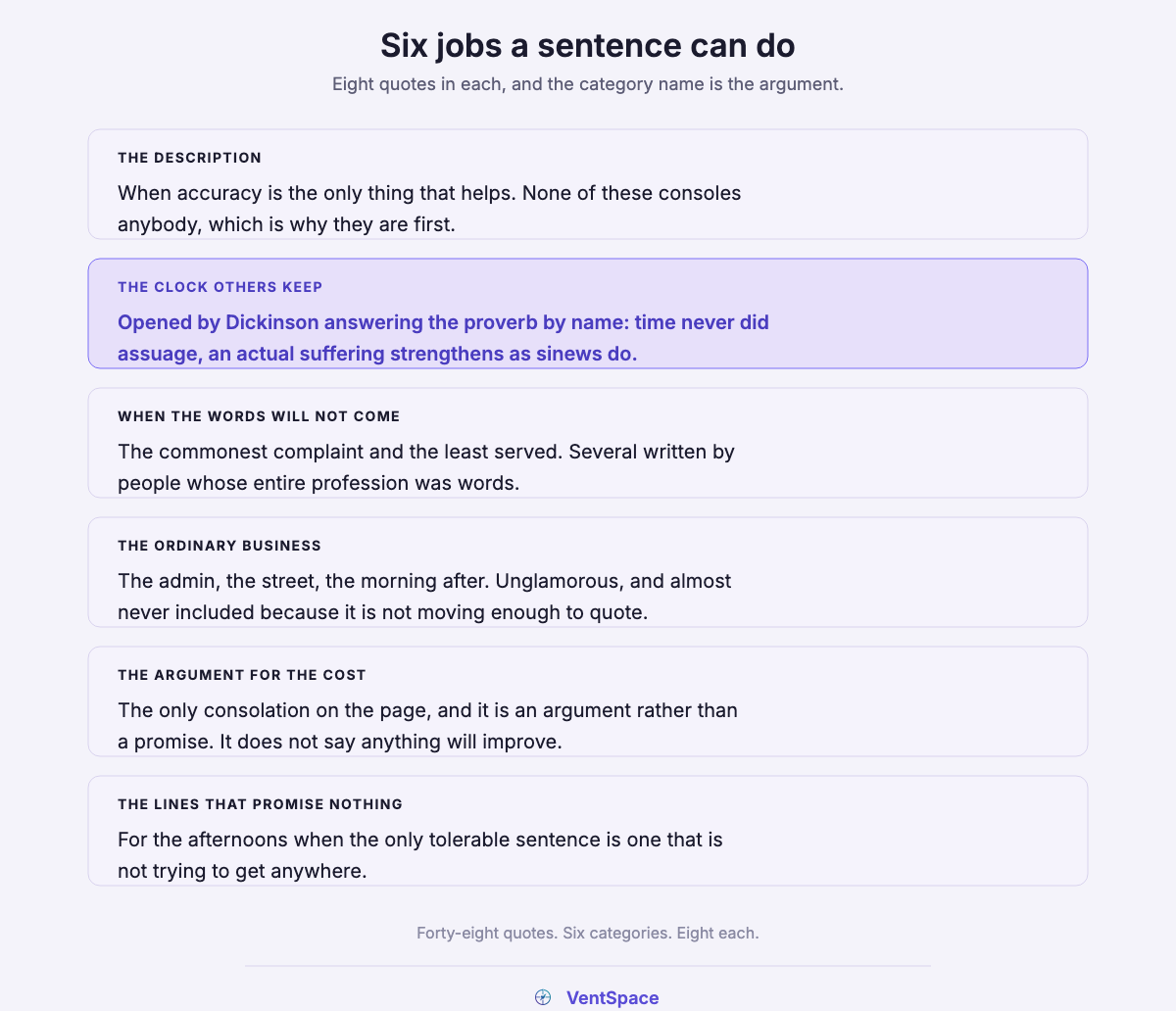
So the forty-four below are not arranged by how far along anybody is supposed to be, which is how this genre is normally organised and which is the thing we have all had quite enough of. They are arranged by what a line is doing. One group describes the sensation and does nothing else. One is for the clock other people are keeping. One is about language failing. One is about the ordinary business the day still contains. One makes the only argument this page is prepared to make, which is that the love was worth what it costs. And one promises nothing at all.
Nothing here does anything about the death. That is the honest position and everything else on the page is written from it.
If you are in crisis or thinking about harming yourself, please contact a crisis line now. In the US you can call or text 988 for the Suicide and Crisis Lifeline. Outside the US, findahelpline.com will find the equivalent where you are.
The short version
Forty-four quotes, each with author, work and year. Most were read inside their own paragraph in the original text rather than lifted from a list.
Sorted by what a line does, not by how far in you are, because the second kind of sorting is the problem.
No quote that implies a schedule. Several good lines were excluded on that alone.
Three corrections to lines this genre repeats without attribution, including the two most-shared modern ones.
No song lyrics. The most-quoted grief line in popular music is not reproduced here, and the reason is at the bottom.
Why these are sorted the way they are
It is worth a paragraph, because the sorting is the argument.
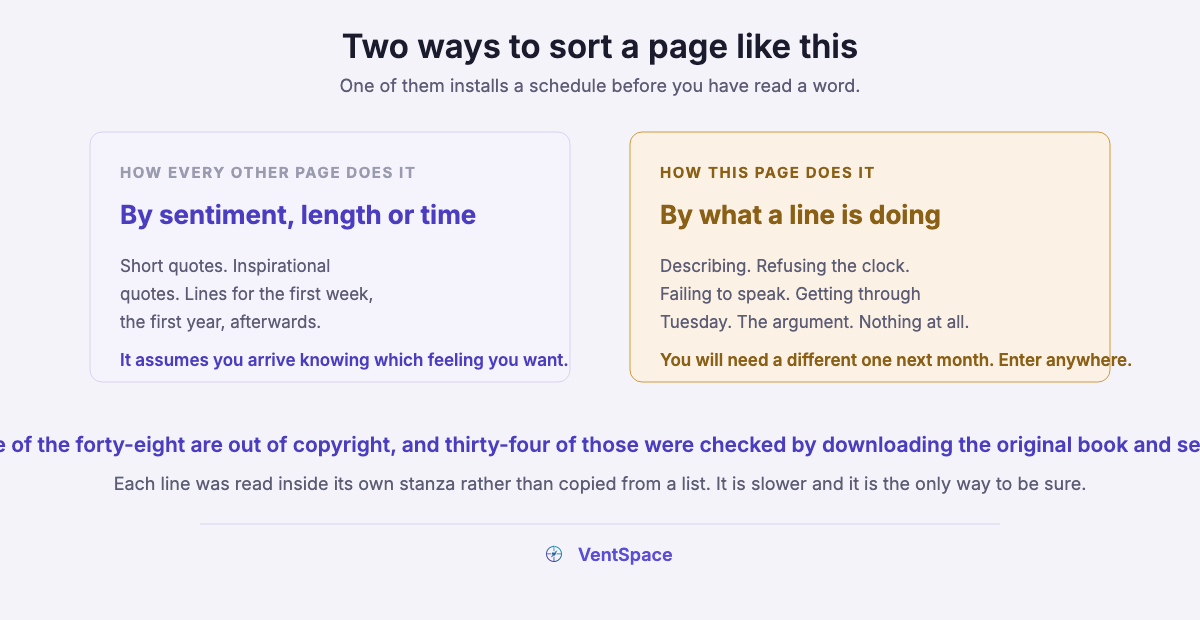
Every competing page groups its lines by sentiment or by length, which assumes we arrive knowing which sort of feeling we want. The difficulty of the first months is that none of us does.
The other common arrangement is by time, and it is worse. A page offering lines for the first week, then the first year, then afterwards, has installed a schedule before we have read a word. That schedule is something we may already have been handed, usually kindly, and it is why we went looking for a sentence at all.
So the grouping here is by job, and the page is meant to be entered at any point rather than read from the top. Most of the lines are out of copyright, and those were checked by downloading the original book and searching it, so each was read inside its own stanza rather than copied from a list. That is slower and it is the only way to be sure.
Quick Summary
Q: How should grief quotes be organised?
A: By what a line is doing rather than by how far along the reader is. Sorting by time installs a schedule before the reader has read a word, and the schedule is usually the thing they came here to get away from. This page groups by job: describing, refusing, the failure of language, the ordinary day, the argument for the cost, and the lines that promise nothing.
For the description, when accuracy is the only thing that helps
The first useful thing a sentence can do is match the sensation. None of the eight below consoles anybody, and that is why they are first.
“No one ever told me that grief felt so like fear. I am not afraid, but the sensation is like being afraid. The same fluttering in the stomach, the same restlessness, the yawning. I keep on swallowing.”
C. S. Lewis, A Grief Observed, 1961
Lewis first published this under a pseudonym, N. W. Clerk.
If you only take one from this category, take that one. Its usefulness is entirely in the fact that it explains nothing.
“Life changes fast. Life changes in the instant. You sit down to dinner and life as you know it ends.”
Joan Didion, The Year of Magical Thinking, 2005
“Grief, when it comes, is nothing we expect it to be.”
Joan Didion, The Year of Magical Thinking, 2005
“I did not know that we cry with our muscles.”
Chimamanda Ngozi Adichie, Notes on Grief, 2021
Written after her father died in Nigeria in June 2020, while she was unable to travel.
“I felt a funeral in my brain,
And mourners, to and fro,
Kept treading, treading, till it seemed
That sense was breaking through.”
Emily Dickinson, Poems, published posthumously 1890 to 1896
“Pain has an element of blank;
It cannot recollect
When it began, or if there were
A day when it was not.”
Emily Dickinson, Poems, 1890 to 1896
“At this grief my heart was utterly darkened; and whatever I beheld was death.”
Augustine, Confessions, Book IV, c. 400, Pusey translation
Augustine is writing about a friend he had known since childhood, and Book IV of the Confessions is one of the oldest sustained descriptions of bereavement in Western writing.
“He is not here; but far away
The noise of life begins again,
And ghastly thro’ the drizzling rain
On the bald street breaks the blank day.”
Alfred Tennyson, In Memoriam A.H.H., 1850, section VII
Quick Summary
Q: What is the most accurate quote about what grief feels like?
A: C. S. Lewis’s opening line of A Grief Observed, that no one ever told him grief felt so like fear. He published it under a pseudonym. Its value is that it describes a sensation without offering any interpretation of it.
For the clock other people are keeping
By a few weeks in, somebody will have mentioned time. The seven here are for that, and the first of them answers the proverb directly.
“They say that ‘time assuages,’
Time never did assuage;
An actual suffering strengthens,
As sinews do, with age.”
Emily Dickinson, Poems, 1890 to 1896
If you only take one from this category, take that one. It is the oldest and flattest refusal available of the single most-repeated sentence in this genre, and it is not a complaint. It is an observation about sinews.
“Grief is not something you pass through, as there is no other side.”
Nick Cave, The Red Hand Files, issue #95, May 2020
Cave answers letters from readers on his own site, and a great many of them are about the death of his son Arthur.
“There is a way, not out of grief, but deep within it.”
Nick Cave, The Red Hand Files, issue #95, May 2020
“That loss is common would not make
My own less bitter, rather more:”
Alfred Tennyson, In Memoriam A.H.H., 1850, section VI
“I myself felt invisible for a period of time, incorporeal. I seemed to have crossed one of those legendary rivers that divide the living from the dead.”
Joan Didion, The Year of Magical Thinking, 2005
“My wariness of superlatives is forever stripped away: June 10, 2020, was the worst day of my life.”
Chimamanda Ngozi Adichie, Notes on Grief, 2021
“Why did you give no hint that night
That quickly after the morrow’s dawn,
And calmly, as if indifferent quite,
You would close your term here, up and be gone”
Thomas Hardy, “The Going”, Satires of Circumstance, 1914, from the sequence Poems of 1912-13
Hardy wrote the 1912-13 poems after the death of his first wife Emma, from whom he had been estranged for years.
Quick Summary
Q: Is there a grief quote that pushes back on “time heals”?
A: Emily Dickinson’s, which answers the proverb by name: they say that time assuages, time never did assuage, an actual suffering strengthens as sinews do with age. Nick Cave’s line that grief is not something you pass through, as there is no other side, does the same job in modern prose.
For when the words will not come out
One difficulty in grief is language: that nothing available is the right size, that everything said sounds either enormous or trivial. These eight are about that, and several of them are written by people whose entire profession was words.
“Give sorrow words. The grief that does not speak
Whispers the o’er-fraught heart, and bids it break.”
William Shakespeare, Macbeth, Act IV scene iii, 1606
Said by Malcolm to Macduff, who has just learned his whole family has been killed. Malcolm is bereaved himself, since his father, King Duncan, was murdered earlier in the play, which makes it one grieving man urging another to speak.
“I sometimes hold it half a sin
To put in words the grief I feel;
For words, like nature, half reveal
And half conceal the Soul within.”
Alfred Tennyson, In Memoriam A.H.H., 1850, section V
If you only take one from this category, take that one. It is the honest counterweight to the Shakespeare, from a man who then wrote a hundred and thirty more sections.
“I have become a problem to myself.”
Augustine, Confessions, Book X, c. 400, Pusey translation
“For whither should my heart flee from my heart? Whither should I flee from myself? Whither not follow myself? And yet I fled out of my country; for so should mine eyes less look for him, where they were not wont to see him.”
Augustine, Confessions, Book IV, c. 400, Pusey translation
“I measure every grief I meet
With analytic eyes;
I wonder if it weighs like mine,
Or has an easier size.”
Emily Dickinson, Poems, 1890 to 1896
“An infant crying in the night:
An infant crying for the light:
And with no language but a cry.”
Alfred Tennyson, In Memoriam A.H.H., 1850, section LIV
“Forgive these wild and wandering cries,
Confusions of a wasted youth;”
Alfred Tennyson, In Memoriam A.H.H., 1850, the prologue
“I am changed. A new voice is pushing out of my writing, full of the closeness I feel to death, the awareness of my own mortality, so finely threaded, so acute.”
Chimamanda Ngozi Adichie, Notes on Grief, 2021
Quick Summary
Q: Why is it so hard to find words for grief?
A: The best-known line on the subject, Shakespeare’s instruction to give sorrow words, is spoken by one bereaved man to another whose loss is only minutes old. Tennyson’s answer, that he sometimes holds it half a sin to put grief into words because words half reveal and half conceal, is the honest counterweight, and he wrote it inside a poem of a hundred and thirty-one sections.
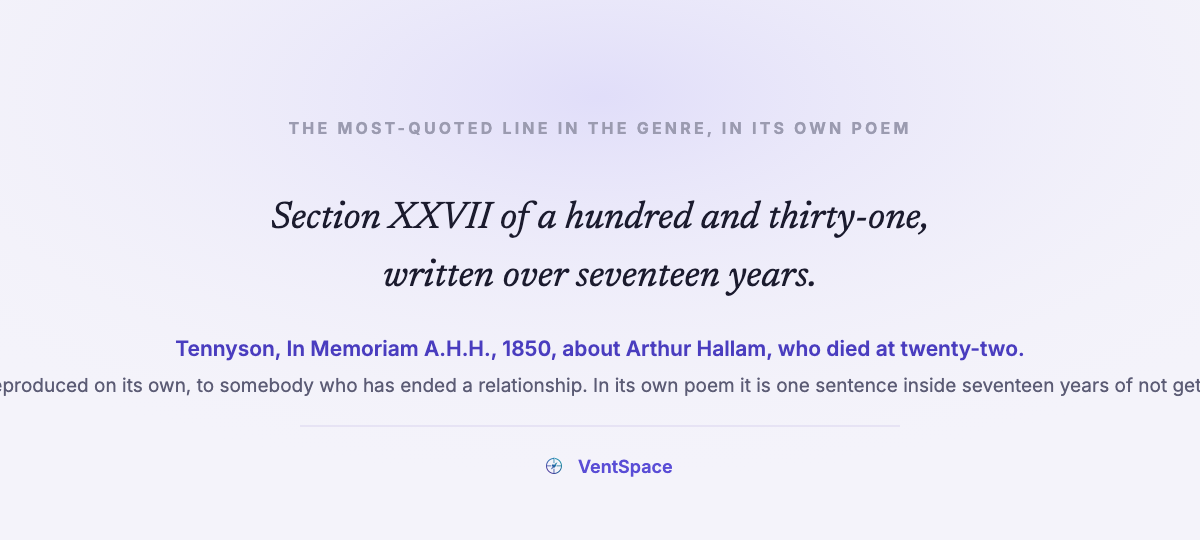
Insight The most-quoted line in this entire genre is section XXVII of a poem with a hundred and thirty-one sections, written over roughly seventeen years, and it is not about a romance. “‘Tis better to have loved and lost than never to have loved at all” is Tennyson on Arthur Hallam, a friend who died at twenty-two of a brain haemorrhage while travelling in Vienna. Reproduced on its own, the line gets addressed to somebody who has ended a relationship. In its own poem it is one sentence inside seventeen years of not getting over somebody.
Alfred Tennyson, In Memoriam A.H.H., 1850
For the ordinary business the day still contains
This is the part that goes unquoted, because it is unglamorous: the admin, the street, the morning, the food that has to be dealt with. Six lines for the hours in which nothing significant is happening and it is still unbearable.
“The bustle in a house
The morning after death
Is solemnest of industries
Enacted upon earth.”
Emily Dickinson, Poems, 1890 to 1896
If you only take one from this category, take that one. Four lines about tidying up, and it is the most exact thing anybody has written about the day after.
“Dark house, by which once more I stand
Here in the long unlovely street,
Doors, where my heart was used to beat
So quickly, waiting for a hand,”
Alfred Tennyson, In Memoriam A.H.H., 1850, section VII
“Mine eyes sought him every where, but he was not granted them; and I hated all places, for that they had not him”
Augustine, Confessions, Book IV, c. 400, Pusey translation
“But I must also feel it as a man:
I cannot but remember such things were,
That were most precious to me.”
William Shakespeare, Macbeth, Act IV scene iii, 1606
Macduff’s reply to the instruction two lines earlier. He is refusing to convert his family into a subject.
“The heart asks pleasure first,
And then, excuse from pain;
And then, those little anodynes
That deaden suffering;
And then, to go to sleep”
Emily Dickinson, Poems, 1890 to 1896
“You were she who abode
By those red-veined rocks far West,”
Thomas Hardy, “The Going”, Satires of Circumstance, 1914
Quick Summary
Q: Is there a grief quote about the ordinary days?
A: Emily Dickinson’s four lines about the bustle in a house the morning after death being the solemnest of industries. It is about tidying up, and it is the most exact thing written about the practical hours, which almost no collection includes because they are not moving enough to quote.
For the argument that the love was worth what it costs
This is the only consolation on the page, and it is an argument rather than a promise. It does not say anything will improve. It says the arithmetic was never in question.
“Perhaps tragedies are only tragedies in the presence of love, which confers meaning to loss. Loss is not felt in the absence of love.”
Elizabeth Alexander, The Light of the World, 2015
If you only take one from this category, take that one. It states the argument in two sentences, with no uplift attached to it.
“I hold it true, whate’er befall;
I feel it, when I sorrow most;
‘Tis better to have loved and lost
Than never to have loved at all.”
Alfred Tennyson, In Memoriam A.H.H., 1850, section XXVII
Read the Insight above before sending this one anywhere. It is not about a romance and it is not a conclusion.
“I had poured out my soul upon the dust, in loving one that must die, as if he would never die”
Augustine, Confessions, Book IV, c. 400, Pusey translation
“The deeper that sorrow carves into your being, the more joy you can contain.”
Kahlil Gibran, The Prophet, 1923, “On Joy and Sorrow”
“When you are sorrowful look again in your heart, and you shall see that in truth you are weeping for that which has been your delight.”
Kahlil Gibran, The Prophet, 1923, “On Joy and Sorrow”
“Remember me when I am gone away,
Gone far away into the silent land;
When you can no more hold me by the hand,
Nor I half turn to go yet turning stay.”
Christina Rossetti, “Remember”, Goblin Market and Other Poems, 1862
“Better by far you should forget and smile
Than that you should remember and be sad.”
Christina Rossetti, “Remember”, Goblin Market and Other Poems, 1862
The second half of the same sonnet reverses the first. Rossetti spends eight lines asking to be remembered and then six taking it back, ending on these two, which is a more honest poem than the half usually printed on memorial cards.
Quick Summary
Q: Is there a grief quote about love being worth the loss?
A: Elizabeth Alexander’s, that tragedies may only be tragedies in the presence of love, and that loss is not felt in its absence. It is an argument rather than a promise, which is why it survives being read on a bad day, unlike most lines in this category.
For the sentences that promise nothing at all
The last eight make no offer. They are here because on some afternoons the only tolerable sentence is one that is not trying to get anywhere.
“Sorrow, then, and all that it teaches one, is my new world.”
Oscar Wilde, De Profundis, written 1897, published 1905
“For the secret of life is suffering. It is what is hidden behind everything.”
Oscar Wilde, De Profundis, written 1897, published 1905
Written in Reading Gaol, and published cut in 1905. The complete text did not appear until 1962.
“Your pain is the breaking of the shell that encloses your understanding. Even as the stone of the fruit must break, that its heart may stand in the sun, so must you know pain.”
Kahlil Gibran, The Prophet, 1923, “On Pain”
“Whatever happens to you belongs to you. Make it yours. Feed it to yourself even if it feels impossible to swallow.”
Cheryl Strayed, Tiny Beautiful Things, 2012
If you only take one from this category, take that one. It is the least comforting sentence on the page, and on some days that is the point.
“Parting is all we know of heaven,
And all we need of hell.”
Emily Dickinson, Poems, 1890 to 1896
“Because I could not stop for Death,
He kindly stopped for me;
The carriage held but just ourselves
And Immortality.”
Emily Dickinson, Poems, 1890 to 1896
“Woman much missed, how you call to me, call to me,”
Thomas Hardy, “The Voice”, Satires of Circumstance, 1914, from Poems of 1912-13
“tell me why weeping is sweet to the miserable”
Augustine, Confessions, Book IV, c. 400, Pusey translation
Sixteen hundred years old, and still the best available statement of the thing nobody can explain about crying.
Quick Summary
Q: What is a grief quote that does not try to console?
A: Cheryl Strayed’s, that whatever happens to you belongs to you, make it yours, feed it to yourself even if it feels impossible to swallow. It offers nothing and asks for something, which on certain afternoons is the only tolerable arrangement.
If what you are carrying does not seem to behave like sadness, that is a real distinction rather than a feeling about yourself: grief vs sadness.
Questions people ask
What is a good quote about grief?
It depends entirely on what you need it to do, which is why this page is sorted the way it is. If you want a line that matches the sensation, Lewis. If you want one that refuses the schedule, Dickinson or Nick Cave. If you want one for an order of service, Rossetti. If you want one that promises nothing, Strayed. A line that is right in week two is frequently unbearable in month nine, and the reverse.
Who wrote “grief is just love with no place to go”?
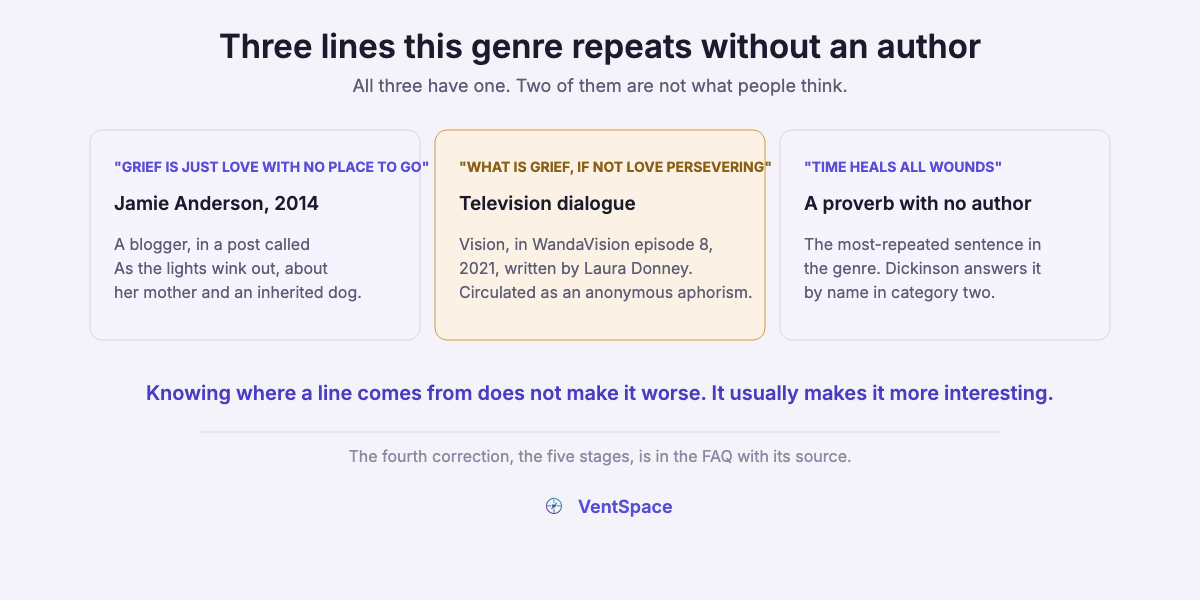
Jamie Anderson, and almost nobody names her. She is a blogger, not a famous novelist, and she wrote it in a post called “As the lights wink out…” on her blog All My Loose Ends on 25 March 2014, about the death of her mother and about a dog she had inherited. The sentence that travels is the last line of a longer passage. One honest limit: the original blog is archived and was not loaded when this page was written, which is why the line appears here as a correction rather than in the list above. The attribution is consistently reported, including by the author.
Is “what is grief, if not love persevering” from a poem?
It is not. It is television dialogue. Vision says it in WandaVision, episode 8, “Previously On”, broadcast in 2021 and written by Laura Donney. It circulates almost everywhere as an anonymous aphorism and occasionally as a line of verse. Knowing where it comes from does not make it worse, and it is the second most-shared sentence in this genre with no author attached.
What about the five stages of grief?
The stage model is contested and this page does not use it. The five stages came from Elisabeth Kübler-Ross’s 1969 work with dying patients, which she extended to their families, and they were never tested in bereaved people before being taught as a sequence. Reviewing the evidence in 2017, Stroebe, Schut and Boerner found stage theory lacking in sound empirical support and concluded it should be discarded, and their sharpest point is the one that matters here: the expectation that bereaved people will, or should, go through stages can be harmful to those who do not. If you have been waiting to arrive somewhere, nothing has gone wrong.
Why are there no song lyrics here?
Because we do not reproduce them, as a rule. It is worth saying plainly that the single most-quoted grief line in English-language popular culture is a lyric, that it is on almost every competing page, and that its absence here is a licensing decision rather than a judgement about the song. That is more interesting than quoting it would have been, because it tells you something about how these pages are assembled.
What do you say to someone else who is grieving?
A different job and a different page. We have written three: what to say when someone is dying, what to say on a death anniversary and what to say when someone loses a pet. The short version is that the name of the dead person does most of the work, and that turning up in week six beats anything said in week one.
What a quote can and cannot do
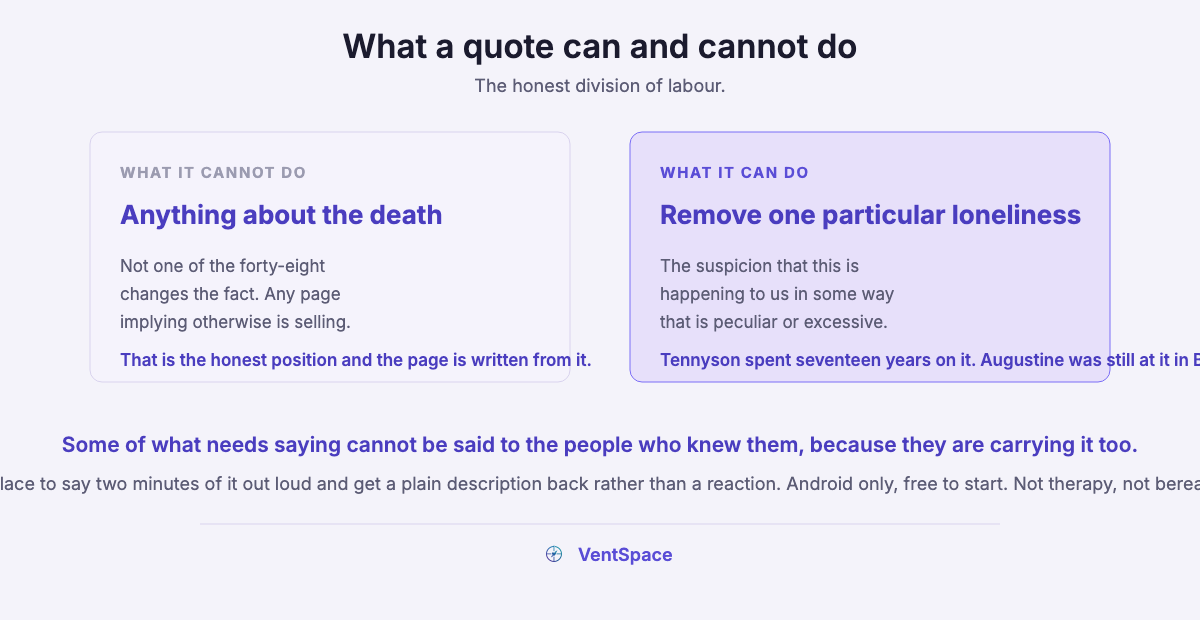
None of these forty-four is going to change the fact of it, and any page that implies otherwise is selling something.
What they can do is narrower and real. They can confirm that the sensation is one other people have had and written down accurately, which removes one particular loneliness: the suspicion that this is happening to us in some way that is peculiar or excessive. Tennyson spent seventeen years on it. Hardy wrote a whole sequence of poems for a wife he had been estranged from for years before she died.
On the days when it is worse than that, the better answer is one of the categories that exists for it: grief counselling, a doctor, or the bereavement service attached to a hospice, which in many places continues long after a death. If grief is not easing, is stopping you living your life, or followed a sudden or violent death, that is the time to ask for that kind of help. And the numbers at the top of this page are better than anything further down it.
If writing is where any of this wants to go, our journal prompts for grief make no promises about where it leads, which is the correct number of promises to make.
If you are carrying a loss right now, whether it is weeks old or years, none of this has to be sorted or finished. If writing some of it down would help, VentSpace is a quiet place to do it: a journaling app we built, where what you write stays yours. If you are on a computer, VentSpace Live runs in your browser, with nothing to install.
About this article

Written by
Sai Subramaniam
Founder, VentSpace
I write these guides because I have been where you are. I am working through my own hard seasons, and I share the things that actually helped me, so that anyone going through it has something steady to read instead of facing it alone. No ads, no affiliate links, and nothing here is a sales pitch.
This writing is honest and every claim is sourced, and it is not a substitute for professional care, bereavement support or medical advice. If this is heavy right now, the numbers above are a better answer than anything else on this page.
How this one was checked. Every factual claim traces to a named source, and the source is printed next to the claim rather than kept in a footnote. Quotes are pinned to the work they come from, with the year, the letter or the chapter where one exists. Where a widely repeated claim could not be traced, it was left out and the omission recorded. Where a figure is contested, both sides are printed.
No affiliate links, no paid placements, and nobody paid to appear here. Where we mention our own app, we say that it is ours, we state its limits, and we never position it as a substitute for care.
Reviewed: October 2026. Prices, platforms and product availability move quickly, and anything we could not verify at the time of writing is marked as unverified rather than turned into a number.
Corrections. If something here is wrong, we would rather know. Corrections are made in place, with a note saying what changed. Updated 15 October 2026: the note on Malcolm in Macbeth was wrong and is corrected (his father had been murdered). Four quotes that could not be confirmed against their source or did not fit the page were removed, so there are now forty-four. Long poems are now quoted in part, the five-stages attribution was made more precise, and some claims about what readers report were removed because we had no source for them.