
Last updated: October 2026.
“Does the content provide original information, reporting, research, or analysis?”
Google Search Central, Creating helpful, reliable, people-first content, last updated 5 October 2026.
On 1 October 2026, Google updated its guidance on AI-generated content to say it is “critical to manually factcheck and review all AI-generated content” before publishing, and it named the parts writers forget: title elements, meta descriptions, structured data and alt text. Four days later it updated its page on helpful content. Neither page bans AI. Both describe the same writer: someone accountable for every claim on the page.
A page ranks and gets cited when it adds something the other results don’t, and someone who would know checked it. Here’s the reason. Google says there are no special requirements to appear in AI Overviews or AI Mode beyond being indexed and eligible for a snippet. And by one detector’s count, about half of new web articles are now mostly machine-written. Fluent, complete, keyword-matched copy is the floor. The page that wins carries the thing a model can’t produce on its own: a first-hand fact, a tested opinion, a real example.
This guide covers the whole job: reading search intent, writing a brief, structuring a page for both search results and AI answers, the trust signals Google describes, AI-assisted drafting inside Google’s rules, and editing and updating. There’s a short section for writers starting out. The page-level technical work lives in on-page SEO, and the AI-search side in depth in our GEO guide.
Quick Digest
– What Google rewards: people-first pages with a clear who, how and why, judged on trust. E-E-A-T describes the goal, it isn’t a score.
– Why fluency stopped being an edge: AI-written articles reached parity with human ones in late 2024, and among ranking pages AI share doesn’t predict position.
– The five steps: read intent from the results, brief the page around what it adds, structure for snippets and citations, show who wrote it and how, use AI for research and structure but not for the claims.
– Editing and updating: a fact-check gate that covers metadata, and refreshes that change the substance, not the date.
– Starting out as a writer: what to build before you pitch.
– One table near the end lists what stopped being true, with dates.
How we know
Sources: Google Search Central pages on helpful content (updated 5 October 2026), generative AI content (1 October 2026), spam policies (28 August 2026), AI features (10 December 2025), the AI optimization guide (10 July 2026) and the SEO starter guide (10 December 2025), each opened on 29 October 2026.
Studies: Graphite’s 43,000-article Common Crawl sample (2020 to May 2025), Ahrefs’ 600,000 ranking pages across 100,000 keywords (July 2025), Ahrefs’ 4 million AI Overview citations (March 2026), and SE Ranking’s 100,000-keyword spam update dataset (August 2026).
The limit: Google says what it looks for, not how much each part weighs. The AI-content studies are correlational and count pages that already rank, so they can’t show the pages that never did. The first-party example is one account.
What does Google reward in content now?
“Of these aspects, trust is most important.”
Google Search Central, on E-E-A-T, Creating helpful content, last updated 5 October 2026.
Google rewards content made primarily to help people, from a source it can trust. Its guidance on helpful content (updated 5 October 2026) frames this as three questions about every page: who created it, how, and why.
- Who: Google asks whether it’s “self-evident to your visitors who authored your content”, and strongly encourages accurate bylines where readers expect them. It also warns against deceptive authorship.
- How: AI or automation disclosures are useful where a reader might wonder how a page was made. Google says to add them when they’d reasonably be expected.
- Why: the “why” should be helping people. Content made primarily to attract search visits is, in Google’s words, not what its systems seek to reward.
E-E-A-T sits inside this, and it isn’t a ranking factor. Experience, expertise, authoritativeness and trust come from Google’s Search Quality Rater Guidelines. The helpful content page says E-E-A-T “isn’t a specific ranking factor”, and the SEO starter guide answers the question “is E-E-A-T a ranking factor?” with “No, it’s not.” Raters don’t move rankings either: “Search raters have no control over how pages rank.” Treat E-E-A-T as a description of the page Google wants, not a checklist you can score.
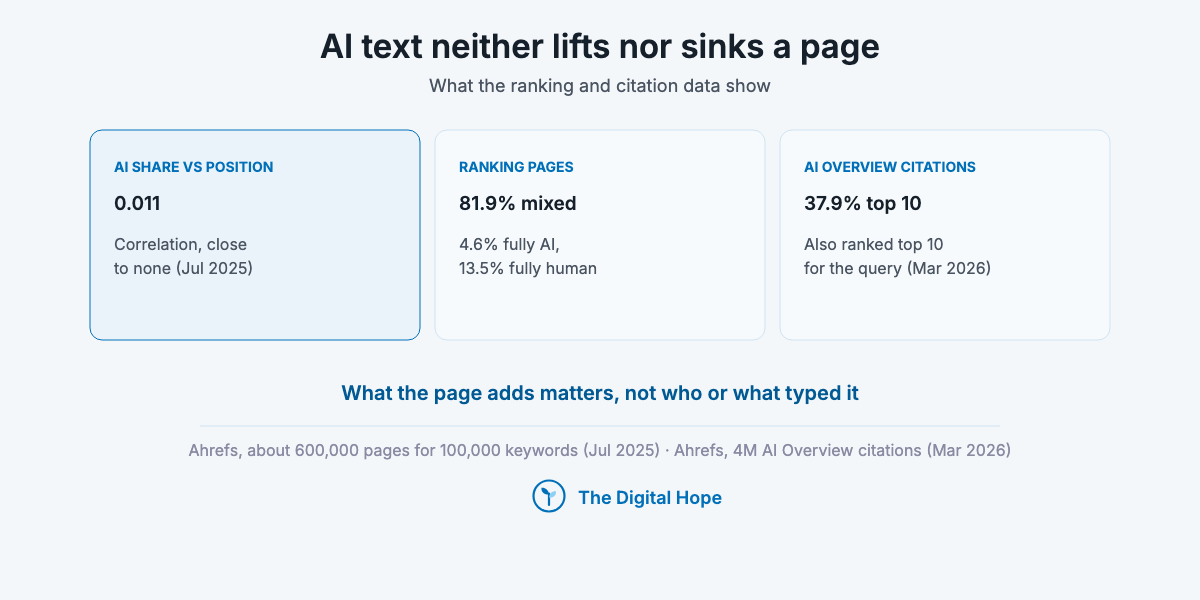
AI answers draw from the same pool. Google’s AI features documentation (updated 10 December 2025) says a page needs to be indexed and eligible for a snippet, with “no additional requirements” for AI Overviews or AI Mode. Those features use query fan-out: they run several related searches across subtopics. That’s why a cited page often isn’t the top result for the query typed. In Ahrefs’ study of 4 million URLs cited in AI Overviews (863,000 keyword results, March 2026), 37.9% also ranked in the top 10 for the same query. The rest were found through the related searches.
So ranking and citation are one job. Write the page that answers the query and the neighbouring questions well, and both surfaces can use it.
Quick Summary
Q: What does Google reward in SEO content?
A: Content made primarily to help people, where it’s clear who wrote it, how it was made and why. Trust is the most important part of E-E-A-T, but E-E-A-T itself isn’t a ranking factor. AI Overviews and AI Mode use the same indexed pages, with no special requirements.
Insight
“We strongly encourage adding accurate authorship information, such as bylines to content where readers might expect it.”
Google Search Central, Creating helpful content, last updated 5 October 2026.
Why fluent writing stopped being enough
“Generative AI can be particularly useful when researching a topic, and to add structure to original content.”
Google Search Central, Using generative AI content, last updated 1 October 2026.
Fluency became free, so it stopped separating pages. In Graphite’s sample of 43,000 English articles from Common Crawl, AI-generated articles passed human-written ones in November 2024, and the share has held roughly level since about May 2024 (Graphite, 2025, one detector with a published 4.2% false-positive rate). When half the new pages read cleanly, reading cleanly isn’t a reason to rank one of them.
AI text doesn’t sink a page either. Ahrefs scored the top 20 results for 100,000 keywords, about 600,000 pages, with its own detector (July 2025). The correlation between AI share and position was 0.011, close to none. Only 4.6% of ranking pages were fully AI, 13.5% fully human and 81.9% mixed. That’s a survivor sample: it counts pages that rank, and says nothing about AI pages that never did.
What Google targets is scale without value. Its spam policies (updated 28 August 2026) define scaled content abuse as many pages generated mainly to manipulate rankings, and the policy applies whether the pages come from automation, people, or both. It names “using generative AI tools or other similar tools to generate many pages without adding value for users” as an example. Spam updates enforce it: in SE Ranking’s 100,000-keyword dataset, a top-10 URL was about 1.8 times as likely to drop out of the top 100 during the August 2026 spam update as in a quiet week in July. The dataset can’t say which sites were hit or why.
The variable that matters is what the page adds. Google’s first quality question is whether content provides “original information, reporting, research, or analysis”. Its AI optimization guide (updated 10 July 2026) makes the same call for AI search: original, first-hand, non-commodity content.
Copy is cheap. Evidence isn’t.
Quick Summary
Q: Does Google penalise AI-written content?
A: Not for being AI-written. Google allows AI-assisted content and asks for manual fact-checking. Its scaled content abuse policy targets many pages made mainly to rank without adding value, however they’re produced.
Insight
“It is critical to manually factcheck and review all AI-generated content for accuracy and trustworthiness before publishing.”
Google Search Central, Using generative AI content, last updated 1 October 2026.
So the work starts before the first sentence is written.
How to write a page that ranks and gets cited: five steps
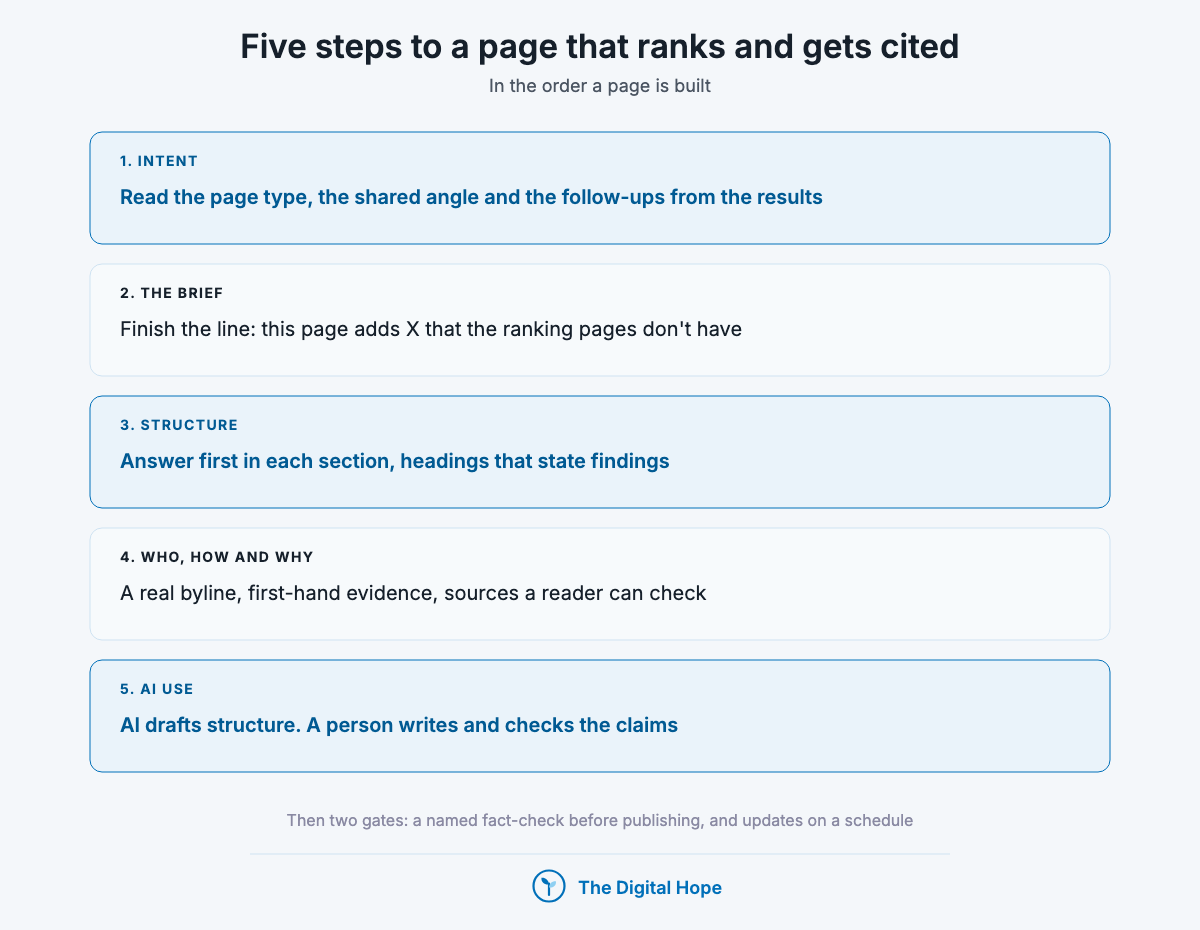
Five steps, in the order a page is built. Each one names its first action in a tool you already have, a check you can run on your own draft, and the condition under which you’d skip it.
1. Read search intent from the results, not the keyword
The first action: search the query in a clean browser, then open the top results and the AI Overview if one shows. Write down three things: the page type that ranks (guide, list, tool, product page, forum thread), the angle most of them share, and the follow-up questions in People also ask and the AI answer.
Intent is what Google already decided the searcher wants. If you see product pages across the first page, a guide won’t fit, however good it is. If it’s forum threads, the searcher wants lived experience, and a polished explainer is the wrong shape. The format choice happens here, before a word is written.
The fan-out questions are the brief’s raw material. AI features run related searches across subtopics, so the neighbouring questions a reader asks next are the ones a cited page tends to answer.
Check your read:
- What page type holds most of the first page, and does your planned page match it?
- What do the ranking pages agree on, and is any of it out of date?
- Which follow-up question does no ranking page answer well?
- Is there a SERP feature (video, local pack, AI Overview) that takes the click before any listing?
When to skip it: never fully. If you’ve written for this query many times, a ten-minute re-check is enough, because intent shifts when Google changes what it shows.
2. Brief the page around what it adds
The first action: before outlining, write one sentence: “This page adds [X] that the ranking pages don’t have.” X can be a survey result, a test you ran, a dataset, a screenshot of a real account, a worked example, or a dated correction to what the ranking pages say. If you can’t fill in X, the page isn’t ready to brief.
A brief is a contract between the person who knows and the person who writes. At minimum it names: the query and its intent (from step 1), the reader and their situation, the one thing this page adds, the sources it must cite, the questions it must answer, the internal links in and out, and who reviews it before it ships.
Avoid briefs built from competitor headings. A brief that copies the H2s of the top five results produces a sixth version of the same page. Google asks whether content draws on other sources while avoiding “simply copying or rewriting those sources”. Use the ranking pages to find what’s missing, not to set the outline.
Check your brief:
- Could a competitor publish a near-identical page tomorrow from public sources?
- Does every number in the brief already have its source, period and sample attached?
- Is the reviewer named, and do they know the subject first-hand?
- Does the brief say what the page will not cover, and which page covers it instead?
When to skip it: for a short news post or a definition, a three-line brief is enough. If you want the page cited, write it in full.
3. Structure the page for snippets and citations
The first action: write the answer to the page’s main question in the first two or three sentences, then make every H2 state a finding, so the headings alone read as the argument.
Google builds snippets from page content. Its snippet documentation (updated 20 April 2026) says snippets are “primarily created from the page content itself”, and a meta description is used only sometimes. So the sentence that answers the question has to exist in the body, plainly, near the top of its section.
The structure that serves both surfaces:
- Answer first in each section, then the reasoning and the evidence.
- Headings that state findings (“Fluency stopped separating pages”) instead of topics (“AI content”).
- Tables for comparisons with two or more options across two or more dimensions.
- Numbers with their receipts in the same sentence: who measured, what sample, what period. A lifted passage keeps its source.
- Self-contained paragraphs: a reader, or a model, landing mid-page should understand the paragraph without the one before it.
What Google says not to bother with. Its AI optimization guide lists llms.txt files, “chunking” content and rewriting pages for AI as myths, and says structured data “isn’t required for generative AI search”. The SEO starter guide says there’s no word-count target, and that heading order doesn’t matter to Google. Good structure is for the reader, and the reader is who the systems model. For page elements such as titles, headings and internal links, use our on-page SEO guide.
Check your structure:
- Does each section answer its question in its first two or three sentences?
- If you read only the headings, do you get the argument?
- Does any key fact live only in an image, a tab or a script-loaded block?
- Is any section padded to hit a length?
When to skip it: only when the ranking pages are tools or product pages. Then structure follows the product, not this list.
4. Show who wrote it, how and why
The first action: put a real byline on the page, linked to an author page that says what the writer has done in this field, and add one line on how the page was made where a reader might wonder.
Trust is shown, not claimed. A credential in the bio counts for less than a page that shows its working: sources named with dates, first-hand results labelled with their context, and corrections made in place. That’s what the “Who, How and Why” questions point at.
The signals that hold up:
- A byline that matches a real person with real work in the subject. Google warns against deceptive authorship.
- First-hand evidence: your own screenshots, tests, numbers and examples, labelled as yours, with the conditions.
- Sources a reader can check: the primary document, not a blog that summarised it.
- A visible reviewed date and a corrections line, honoured when something changes.
- A disclosure of AI use where it would reasonably be expected, as Google’s page suggests.
Check your page:
- Would a reader know who wrote this and why they’re qualified, without searching?
- Is every first-hand claim labelled as one account, with its period?
- Does any sentence only work because the reader assumes an expert wrote it?
When to skip it: never on topics where readers act with money, health or legal risk. Those pages need the strongest version of every signal. For B2B pages, where the reader is shortlisting a vendor, the byline and the first-hand evidence carry most of that trust.
5. Use AI for research and structure, not for the claims
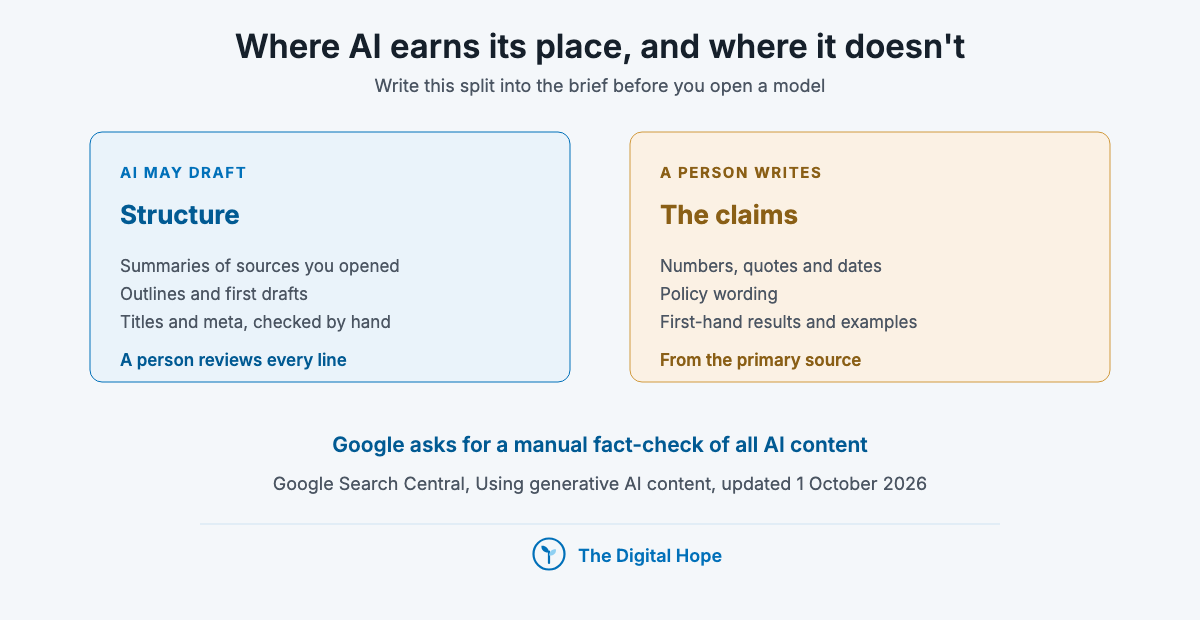
The first action: decide, before you open a model, which parts it may draft (outlines, first passes of explanatory sections, summaries of sources you’ve read) and which parts it may not (numbers, quotes, dates, policy statements, first-hand results). Write that split into the brief, and if you work with freelance writers, put it in their brief too.
Google’s line is clear on use and on checking. Its generative AI content guidance says AI “can be particularly useful when researching a topic, and to add structure to original content”, and that publishers should manually fact-check and review everything AI-generated, including titles, meta descriptions, structured data and alt text. The risk sits in volume without value, which the scaled content abuse policy covers whoever, or whatever, writes the pages.
In one account I ran (Clarifai, a B2B AI infrastructure company, July 2025 to May 2026, solo), I published 3 to 4 AI-assisted articles a week, and rankings held stable. That’s one site, with no baseline or comparison group, and it doesn’t show the pace is safe in general. My read, which one account can’t prove: the pace held because the articles were AI-assisted, not AI-written.
Where AI earns its place, and where it doesn’t:
| Task | Use AI? | Condition |
|---|---|---|
| Summarising sources you’ve opened | Yes | You check each summary against the source |
| Outline and first draft of explanatory sections | Yes | The brief’s “this page adds” line is written by a person |
| Titles, meta descriptions, alt text | Draft only | Reviewed by hand, as Google’s guidance says |
| Numbers, quotes, dates, policy wording | No | Taken from the primary source and checked |
| First-hand results and examples | No | They come from the person who has them |
| Publishing many near-identical pages | No | This is what the scaled content abuse policy describes |
Check your AI-assisted draft:
- Can you trace every number, quote and date to a source you opened yourself?
- Did a person write the part of the page no model could?
- Would you publish this page if Google asked how it was made?
When to skip it: on pages built almost entirely from first-hand material, such as a case study, AI saves little and adds checking work.
Quick Summary
Q: How do you write SEO content that ranks and gets cited?
A: Read the intent from the ranking results, brief the page around one thing it adds, answer each section’s question first under headings that state findings, show who wrote it and how, and use AI for research and structure while a person writes and checks the claims.
Insight
“There are no additional requirements to appear in AI Overviews or AI Mode, nor other special optimizations necessary.”
Google Search Central, AI features and your website, last updated 10 December 2025.
How to edit and update a page so it keeps ranking
“Are you changing the date of pages to make them seem fresh when the content has not substantially changed?”
Google Search Central, Creating helpful content, one of its signs of search engine-first content, last updated 5 October 2026.
Editing is where accountability happens, and updating is where most of the value sits on a site with a library. Two gates, each with an owner.
The fact-check gate, before publishing.
- Every number carries who measured it, the sample and the period, in the same sentence or the next.
- Every platform claim cites the platform’s own documentation, with the date the page was last updated.
- Every quote is checked against its source, word for word.
- Metadata gets the same check as the body: title, meta description, structured data and alt text, per Google’s October 2026 guidance.
- One named person signs off, and their name is on the page or in the editorial record.
The update gate, on a schedule. Open Search Console’s Performance report, filter to the page, and compare the last three months with the three before. Pages losing impressions for queries they used to rank on are the update list. Run it monthly if you publish weekly, and quarterly if you publish less often. Then decide per page:
- If the facts changed (a policy, a feature, a price): rewrite the affected sections, change the reviewed date, and say what changed.
- If the intent changed (the results now show a different page type): rebuild the page to the new shape, or let a better-fitting page on your site take the query.
- If nothing changed and the page still slipped: look at what the new top results add that yours doesn’t. Add that, or accept the position.
- If the page never earned impressions: merge it into a stronger page with a 301, or remove it.
A new date without new substance doesn’t count. Google lists exactly that as a sign of search engine-first content. Chat assistants did lean newer: in Ahrefs’ July 2025 study of about 17 million cited URLs, assistants cited content about 25.7% newer than Google’s organic results, while AI Overviews didn’t prefer newer pages. Even then, the average cited page was close to three years old.
In one B2B account I run (Forage AI, 2026), blog traffic rose 127% from Q1 to Q3 at about 50 posts a quarter, while total impressions fell from 208K to 132K as older posts decayed and the focus moved to US buyer terms. That’s one site, and the decay and the deliberate refocus can’t be separated. It’s why, when you publish at that pace, the update list gets its own time in the calendar: new posts and old-post decay run at the same time. For running that calendar as a system, see our content marketing guide, and for diagnosing a sitewide drop, the SEO audit checklist.
Quick Summary
Q: How often should you update SEO content?
A: Review pages on a schedule in Search Console and update when facts, intent or competitors change. Change the date only when the substance changed, since Google lists date-only refreshes as search engine-first behaviour. Merge or remove pages that never earned impressions.
Insight
“Rater data is not used directly in our ranking algorithms.”
Google Search Central, Creating helpful content, on the Search Quality Rater Guidelines, last updated 5 October 2026.
Starting out as an SEO content writer
If you came here looking for writing work, the portfolio matters more than the job board. With about half of new web articles mostly machine-written by Graphite’s count, fluency doesn’t set a candidate apart. Evidence of judgement does: a page that ranks, a brief you wrote, a fact-check you caught.
What to build before you pitch:
- Three published pieces in one subject you know first-hand. A vertical where you’ve worked, studied or spent money beats a general portfolio.
- One page on your own site with its Search Console data. Even a small site shows you can read impressions, clicks and queries, and that you wrote for a real intent.
- A sample brief and an edited draft. Show the “this page adds” line, the sources you checked, and what you cut.
- A short note on how you use AI. Expect to be asked when you apply. Say what you draft with it and what you never hand to it, in the terms of step 5.
Where the condition splits:
- If you’re a subject expert learning SEO (an accountant, a developer, a nurse), lead with the subject. The SEO structure is learnable, and your first-hand knowledge is what the page can’t get elsewhere.
- If you’re a writer learning a subject, pick one vertical and go deep enough to brief your own pages. A page you briefed yourself shows more than one you were handed.
The skills that compound: reading a results page for intent, writing a brief, finding and citing primary sources, and reading Search Console. Those carry from one client to the next.
Learn the measurement as early as the writing.
Pulling it all together
Step 1, intent: search the query, note the page type, the shared angle and the follow-up questions. Write down the format you’ll use.
Step 2, the brief: finish the sentence “This page adds [X]”, name the sources and the reviewer, and list what the page won’t cover.
Step 3, structure: answer each section’s question first, write headings that state findings, and put comparisons in tables with their sources.
Step 4, who, how and why: add a real byline with a linked author page, label first-hand results with their context, and disclose AI use where a reader would expect it.
Step 5, AI: write the split of what AI may and may not draft into the brief, then check every number, quote, date and metadata field by hand.
Then the two gates: a named person signs off the fact-check before publishing, and the update list comes from Search Console on a schedule.
What stopped being true
These were standard SEO writing advice and stopped holding on dates you can check. None of them belongs in a current brief.
| What | When | Primary source |
|---|---|---|
| Writing for a separate “Helpful Content Update” | Folded into Google’s core ranking systems in March 2024 | Google Search Central, helpful content system page |
| A target word count, or “longer articles rank better” | Google: no preferred word count, and length alone doesn’t matter for ranking | Creating helpful content (5 October 2026), SEO starter guide (10 December 2025) |
| Keyword density targets and the meta keywords tag | Google doesn’t use meta keywords, and keyword stuffing is a spam policy | SEO starter guide, updated 10 December 2025 |
| E-E-A-T as a score to raise | Google: E-E-A-T “isn’t a specific ranking factor”, and rater data isn’t used directly in ranking | Creating helpful content, updated 5 October 2026 |
| “Scaled content is fine if people write it” | Scaled content abuse covers automation, people or both, since 5 March 2024 | Google spam policies, updated 28 August 2026 |
| “Google is fine with AI content” as a blanket rule | Guidance asks for manual fact-checking of AI content, including titles, meta descriptions, structured data and alt text | Using generative AI content, updated 1 October 2026 |
| Adding FAQ or HowTo markup to win extra results space | HowTo results ended September 2023, FAQ rich results stopped showing on 7 May 2026 | Google Search Central, search gallery and announcements |
| Guest posts with keyword anchors, directory and bookmark links to lift a new article | Named as link spam examples | Google spam policies, updated 28 August 2026 |
| Titles of 50 to 60 characters and descriptions of 150 to 160 as Google rules | Google sets no length limit on either and truncates to fit | Snippet documentation (20 April 2026), title link documentation (10 December 2025) |
| Special AI markup, llms.txt or “chunked” pages to get into AI answers | Google lists all three as myths, and says structured data isn’t required for generative AI search | AI optimization guide, updated 10 July 2026 |
Frequently asked questions
What is SEO content writing? SEO content writing is writing pages that match what searchers want for a query, in a form search engines and AI answers can find, understand and cite. In 2026 that means reading intent from the results, adding something the ranking pages don’t have, and checking every claim.
Is AI-generated content bad for SEO? No, not for being AI-generated. Google allows AI-assisted content and asks for manual fact-checking, including metadata. What its spam policy targets is many pages made mainly to rank without adding value, whether a model or a person produced them.
Is E-E-A-T a ranking factor? No. Google’s SEO starter guide answers that question with “No, it’s not”, and its helpful content page says E-E-A-T “isn’t a specific ranking factor”. It describes the kind of page Google’s systems aim to reward, with trust as the most important part.
How long should an SEO article be? As long as the answer needs. Google says it has no preferred word count and that length alone doesn’t matter for ranking. Match the depth of the pages that rank for the query, then stop when you’ve answered the reader’s questions.
Do I need to write differently for AI Overviews and ChatGPT? Not for Google’s AI features: Google says a page needs to be indexed and snippet-eligible, with no special requirements, and calls content chunking and llms.txt myths. Answer-first sections, findings as headings and sourced numbers help both the results page and the AI answer.
How do I become an SEO content writer? Build three published pieces in a subject you know first-hand, one page on your own site with its Search Console data, and a sample brief. Learn to read intent and Search Console early, and be ready to explain how you use AI.
In a nutshell
Write the page that adds something, and put your name on every claim in it. That’s what ranks and what gets cited, because Google’s ranking systems and its AI features are choosing from the same pages by the same idea of trust. It holds for a solo writer and a content team alike. What changes the call is scale: if you publish dozens of pages a month, the fact-check gate needs to be written down and owned, or the volume starts to look like what the scaled content abuse policy describes.
Expect months, not weeks, and no guarantee. Google says “there’s no guarantee that changes you make to your website will result in noticeable impact”, and some pages never rank however good they are. What would change this advice: Google naming a publishing-rate signal, or reporting AI clicks separately in Search Console.
If you want to go further than this guide, with briefs, worked examples and the editing process step by step, I teach it in my SEO Content Writing Course.
About this article

Written by
Sai Subramaniam
SEO, GEO and Paid Ads Manager · 8+ years in growth marketing
I have run SEO, paid media and ABM for B2B AI companies, consumer apps and live-entertainment brands, from a solo operator at an AI infrastructure company to a team of 20 recovering a million-visitor site after a Google update. I write these guides from that work, and every number in them carries its source.
See my portfolioConnect on LinkedInHow this one was checked. Every number traces to a named source with its dataset and period, and every platform feature, policy or limit cites the platform’s own documentation with the date it was verified. Where the author’s own results appear, they are labelled as one account’s results, with the budget and context, not as a rule.
No affiliate links and no paid placements. Tools are named because they are what practitioners use, not because anyone paid to appear here.
Reviewed: October 2026. Ad platforms and search features change every few months; anything we could not verify at the time of writing is marked as unverified rather than turned into a number.
Corrections. If something here is wrong or has changed since, we would rather know. Corrections are made in place, with a note saying what changed.