
“With ambiguous loss, closure is a myth.”
Pauline Boss, “The Context and Process of Theory Development: The Story of Ambiguous Loss”, Journal of Family Theory & Review, 2016
Some losses arrive with paperwork: a date, a certificate, a funeral, and everyone around you knows. Others arrive with none of it. A father who some weeks does not know your name. A brother who has not been found. A death the family has agreed not to mention.
Ambiguous loss describes the loss itself: it is unclear whether, or how far, the person is gone. Disenfranchised grief describes the response: the people around you do not count what you are grieving. “Ambiguous grief” is the name most pages give to the grief that follows the first.
The two can arrive together, because an unclear loss comes with no funeral or ritual to tell anyone it happened, and that is why we tend to use them as if they meant the same thing. They do not, and the difference matters, because one of them can be eased by other people, and the other may never be resolved. Neither is a diagnosis, and neither means your grief is wrong. How to tell which one is yours is further down.
If you are struggling right now. If you are in crisis or thinking about harming yourself, please contact a crisis line now. In the US, call or text 988 (Suicide & Crisis Lifeline). Anywhere else, findahelpline.com lists free, confidential services by country. This page explains two terms and is not a substitute for that help.
The short version
Ambiguous loss is a loss that stays unclear: the person is missing, or is here but no longer fully themselves. Pauline Boss coined the term in the 1970s.
Disenfranchised grief is grief that others do not acknowledge or make room for. It is Kenneth Doka’s term, from a 1989 book.
One describes the loss. The other describes the response to it. They can travel together, because an unclear loss rarely comes with a funeral.
Neither is a diagnosis, and Boss calls the idea of closure a myth.
You can be in both at once. Knowing which half is which tells you what kind of help to look for.
What is ambiguous loss?
Ambiguous loss is a loss that cannot be confirmed, and so cannot be finished. Pauline Boss, the family therapist and researcher who coined the term, defines it as “a situation of unclear loss that remains unverified and thus without resolution”. She describes two types.
- Physical absence, psychological presence. The person is gone but not known to be dead: someone missing in a war or a disaster, a body never recovered. Boss writes that families call this “gone, but not for sure.”
- Psychological absence, physical presence. The person is in the room but no longer fully there, through dementia, brain injury, illness or addiction. Families, she reports, call this “here, but not here.”
Her first research on it, in the early 1970s, was with families of pilots declared missing in action in the Vietnam War. The second major testing, in the 1980s, was with families of veterans with Alzheimer’s disease. Her own list of examples is much wider than death, and includes divorce, migration and adoption. We keep this page to the losses closest to bereavement: someone dying slowly, someone no longer themselves, someone missing.
Many pages call the grief that follows “ambiguous grief”. Boss’s own term is ambiguous loss, and her 1999 book on it is subtitled Learning to Live with Unresolved Grief. A son interviewed for a 2026 study of 38 family carers of people with dementia, in Australia and Japan, described his father this way:
“And now that I find that he’s losing that identity. Some part of me feels like that person is already dying, If that makes sense.”
Quick Summary
Q: What is ambiguous loss?
A: A loss that stays unclear and unconfirmed, so it cannot be resolved. Pauline Boss describes two types: a person who is physically gone but may be alive, such as someone missing, and a person who is physically present but psychologically gone, such as someone with dementia.
Insight: “With physical ambiguous loss, families do not know where their loved ones are or whether they are dead or alive.” Pauline Boss, Journal of Family Theory & Review, 2016.
What is disenfranchised grief?
Disenfranchised grief is grief that is real but not allowed. The gerontologist Kenneth Doka defines it as “the grief that is experienced when a loss cannot be openly acknowledged, socially sanctioned, or publicly mourned”, in the wording of his 2002 chapter as quoted by the researcher Jillian Tullis.
Tullis, summarizing Doka, describes it happening in a few ways: when the relationship is not recognized (her own example is the death of her ex-husband), when the loss is not seen as legitimate (the death of a pet, a pregnancy lost early), and when the griever is not thought able to grieve (a spouse with dementia who is not told about a death).
The death of a close friend is one of the clearest cases. An Australian study that followed more than 26,000 people found small but lasting effects on health and wellbeing, for up to four years, in those whose close friend died, and its authors called what they found disenfranchised grief. A participant in a 2026 UK study of bereavement across nine ethnic groups, describing an unwritten rule in some families that grief stays hidden, put it this way:
“…this concept of grief just doesn’t exist. It just gets buried.”
Quick Summary
Q: What is disenfranchised grief?
A: Grief that other people do not acknowledge, permit or mourn alongside you. Kenneth Doka’s term covers relationships that are not recognized, losses not seen as real, and people not thought able to grieve: a friend, an ex, a pet, a pregnancy.
Insight: The authors of the Australian close-friend study concluded that there is “a need to recognise the death of a close friend as a substantial experience”. Liu, Forbat and Anderson, PLoS ONE, 2019.
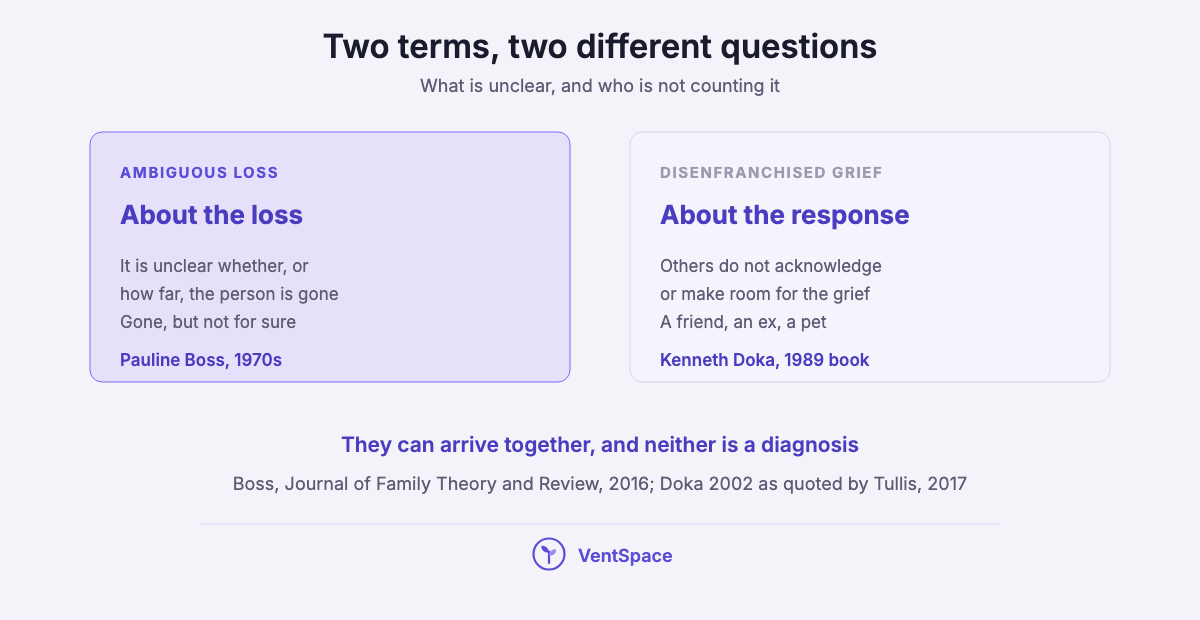
Ambiguous loss and disenfranchised grief side by side
| Ambiguous loss | Disenfranchised grief | |
|---|---|---|
| What it describes | The loss: what is known about whether the person is gone | The response: whether others let you grieve |
| Whose term | Pauline Boss, family therapist (1970s) | Kenneth Doka, gerontologist (1989 book) |
| Has someone died? | Not known, or not yet | Not necessarily: Doka’s definition says “a loss” |
| What is missing | Certainty | Recognition |
| Who could change it | Possibly nobody: Boss says it may never be clarified | Other people, by acknowledging the loss |
| Is it a diagnosis? | No. Boss treats it as a situation, not a disorder | No. It describes a social response |
| One example | A parent with dementia who is here but not here | The death of an ex-partner nobody asks you about |
One names the loss, the other names the people around it
Ambiguous loss is a fact about the loss. Disenfranchised grief is a fact about the room. Boss is precise on this: in her account, ambiguous loss is “the stressor event or situation”, something that happens to a family. Doka’s definition, by contrast, is all about other people: whether a loss can be acknowledged, sanctioned and mourned in public.
Put the two definitions side by side and they answer different questions. Boss’s asks what you know about whether this person is gone. Doka’s asks who is letting you grieve. We should say plainly that this way of separating them is our reading of the two definitions. Neither author, in the texts we read, sets the terms against each other.
It is a useful separation all the same, because it is easy to feel both and not know which part hurts. The uncertainty is one weight. The silence of the people around it is another. Naming them separately can make each one easier to look at.
Quick Summary
Q: What is the difference between ambiguous loss and disenfranchised grief?
A: Ambiguous loss describes the loss itself: it is unclear whether, or how far, the person is gone. Disenfranchised grief describes the response: other people do not acknowledge the grief. One is about the facts, the other about recognition.
Insight: The first of the assumptions Boss lists beneath her theory: “A phenomenon can exist even if it cannot be measured.” Journal of Family Theory & Review, 2016.
Why does an ambiguous loss go uncounted?
Because nothing happens that other people can respond to. Boss puts it in one sentence: “Unlike with death, there is no official verification of loss and thus no finality with rituals of support.” There is no funeral to attend, no date to mark, no card that fits.
What fills the gap, she writes, is judgment. People “are often criticized for not ‘finding closure’ and left on their own to cope.” The grief is there, and the social signal that would let others meet it never arrives. That is the bridge between the two terms. An ambiguous loss is not disenfranchised by definition, but it starts with every disadvantage.
We tend to wait for an event before we offer comfort. A diagnosis, a death, a service. An ambiguous loss never supplies the event, so the people who would have come do not know when to come, and the person grieving learns to stop mentioning it.
Quick Summary
Q: Why does ambiguous grief go unrecognized?
A: Because there is no death certificate, funeral or ritual to tell others a loss has happened. Pauline Boss notes that families are often left to cope alone and criticized for not “finding closure”, which is how an unclear loss can become an unacknowledged grief as well.
Insight: “People cannot cope with a problem until they know what the problem is. Naming the stressor as ambiguous loss therefore allows the coping process to begin.” Pauline Boss, Journal of Family Theory & Review, 2016.
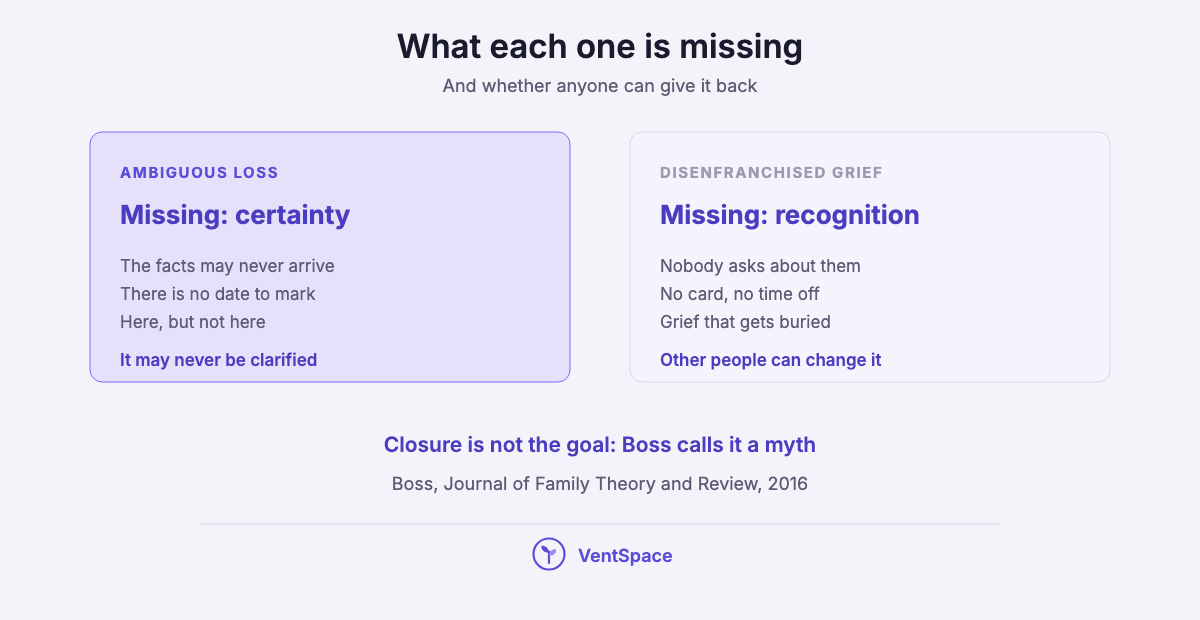
What each one is missing, and who can give it back
An ambiguous loss is missing certainty, and certainty may never come. Boss is direct about this: “Because an ambiguous loss may never be clarified, the goal of intervention is resilience.” The people closest to these losses describe holding two things at once. A family caregiver of someone in a permanent vegetative state, one of 13 interviewed in northeastern Italy for a 2026 study (interviews translated from Italian), said:
“I had already put myself in the idea of the funeral and these processes, but inside me, I continued to hope for something different.”
Disenfranchised grief is missing recognition, and recognition is something other people can give. That is the hopeful half of the distinction. A friend cannot tell you whether your brother is alive. A friend can ask about him, say his name and remember the day he went missing. One parent in the University of Oxford’s published collection of accounts of losing a baby at 20 to 24 weeks of pregnancy remembered a friend who asked to see a picture of him: “And that made so much of a difference. Just asking.”
So the question of what helps has a different answer for each half. For the uncertainty, there may be nothing to do but learn to carry it. For the silence, there may be a person who could break it.
Quick Summary
Q: Can you get closure from an ambiguous loss?
A: Often not, and Pauline Boss argues that closure is the wrong goal. An ambiguous loss may never be clarified. What can change is the disenfranchised part: other people can acknowledge the loss even when nobody can resolve it.
Insight: “Closure is a good term for real estate and business deals in which there are true absolutes and clear conclusions, but it is not a valid term for human relationships.” Pauline Boss, Journal of Family Theory & Review, 2016.
Is ambiguous grief a diagnosis?
No. Neither ambiguous loss nor disenfranchised grief is a diagnosis. Boss’s theory treats ambiguous loss as a situation a family is in, and her approach to building resilience includes, in her words, “telling families that their distress is not their fault”. A 2026 analysis of 36 articles on grief before a death treated ambiguous loss as a related idea rather than the same one, writing that it “helps explain physical presence with psychological or relational alteration, especially in dementia caregiving, whereas bereavement grief occurs after death.”
The diagnosis that does exist for grief is prolonged grief disorder, in both of the main diagnostic manuals. It describes grief that is severe, persistent and disabling beyond what is normal in a person’s culture, and only a professional can assess it. Researchers still disagree about exactly where ordinary grief ends, and the American manual’s timing was set, as the researchers who validated its criteria put it, to be sensitive to concern about “pathologizing normal grieving”. The reason to look for help is how heavy it is and how much it is stopping you living, never the calendar.
If it is heavy right now: call or text 988 in the US, or find a local crisis line at findahelpline.com. You do not need a diagnosis, or a death, to reach out.
Quick Summary
Q: Is ambiguous grief a mental illness?
A: No. Ambiguous loss and disenfranchised grief describe situations and responses, not disorders. The grief diagnosis that exists, prolonged grief disorder, is for grief that is severe, persistent and disabling, and only a professional can assess it.
Insight: “With ambiguous loss, the source of pathology lies in the type of loss and not in the type of grief.” Pauline Boss, Journal of Family Theory & Review, 2016.
How to tell which one you are in
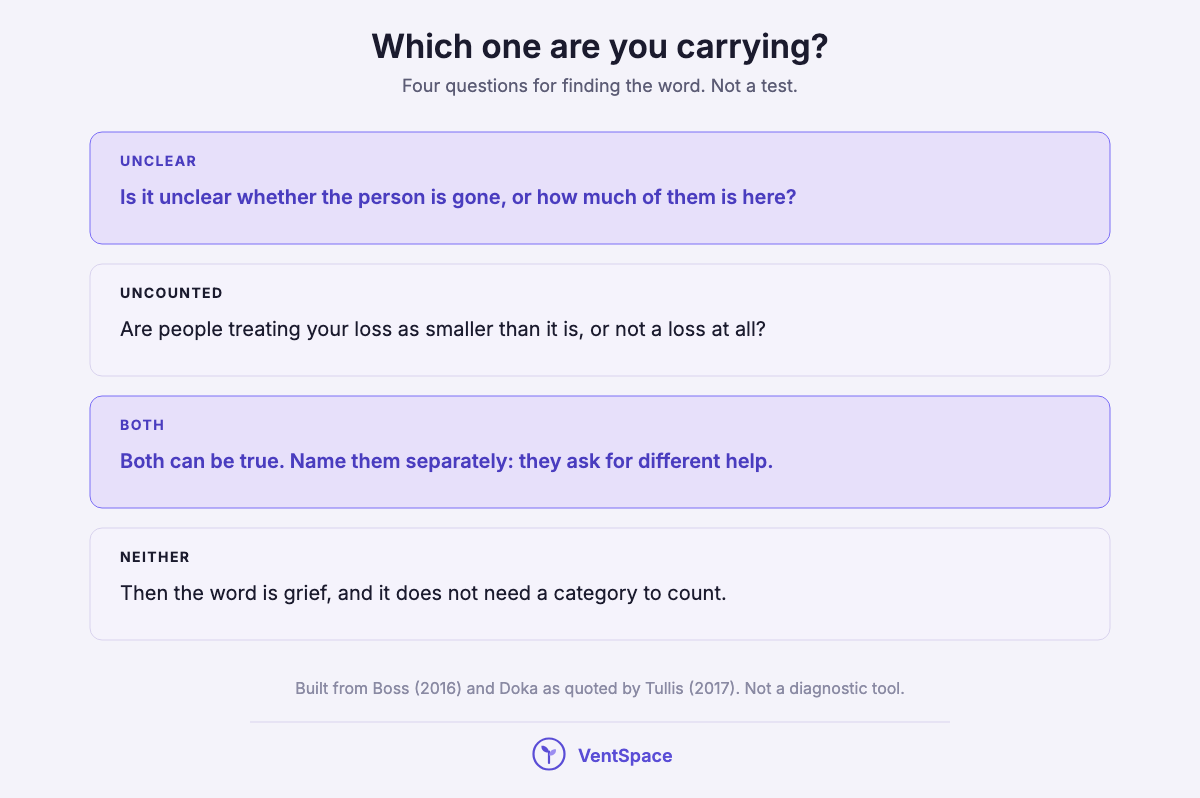
This is not a test, and it does not diagnose anything. It is four questions for finding the right word.
- Is it unclear whether the person is gone, or how much of them is still here? That is ambiguous loss.
- Are the people around you treating your loss as smaller than it is, or not as a loss at all? That is disenfranchised grief.
- Are both true? Then you are carrying both, and it helps to name them separately, because they ask for different things.
- Does neither fit? Then the word is grief, and it does not need a special category to count.
What to do in each case
If the loss is ambiguous, try writing it in Boss’s “both/and” form, which holds the two truths without forcing a verdict. Her own examples include “He is both here and also gone” and “My grandfather who has dementia is still here but also gone.” Boss sets out six guidelines for living with this kind of loss (finding meaning, adjusting mastery, reconstructing identity, normalizing ambivalence, revising attachment and discovering new hope), developed in her 2006 book for professionals. If the person is seriously ill or dying, palliative care is for families too: the World Health Organization describes a team approach “to support patients and their caregivers”, including “bereavement counselling”.
For carers of someone with dementia, the grief before a death is real and has been measured. A 2025 review of 12 studies found less of it where carers had coping resources and support from friends and family, and a 2026 meta-analysis found little short- or medium-term effect from the programs tested so far. If the person is missing, ask whoever is handling the case what support exists for families.
If the grief is disenfranchised, tell one person what you lost and who they were. Ask for something specific: “Ask me about him”, “Come with me on the day.” If you are the friend reading this for someone else, say the person’s name. Our page on what to say when someone is dying goes further on showing up.
And in either case, most people are carried through grief by the people around them, and needing more than that is not failure. If the grief is severe, is not easing and is stopping you living, that is a reason to talk to a doctor or a bereavement service. Therapy and grief counseling are legitimate options, and for some people they are the right one. If writing helps you think, our journal prompts for grief are built for days when there is nothing to fix.
Where the line blurs
The honest admission is that the split we have drawn is cleaner than life. A daughter whose mother has dementia may be grieving someone still alive and also find that nobody asks how she is. A family whose son is missing may be told, kindly, that it is time to move on. Those are both at once, and cases like these are part of why the two terms get used as one.
There is also a scope question we have stepped around on purpose. Boss’s theory covers losses where nobody has died or will die soon, such as divorce and estrangement, and people use “disenfranchised grief” for those too. Our grief pages stay with death and dying, which is why this one does.
Questions people ask
Is ambiguous grief the same as anticipatory grief?
They overlap but are not the same. Anticipatory or pre-death grief is grief before an expected death. Ambiguous loss is about uncertainty: the person may be present but changed, or absent but not known to be dead. A parent with dementia can bring both. For how grief differs from sadness, see our page on grief vs sadness.
Can you grieve someone who is still alive?
Yes. Boss’s second type of ambiguous loss is exactly this: a person physically present and psychologically gone. Researchers studying dementia carers measure grief before a death with its own scales. It is not premature and it is not a betrayal.
Do you need closure to move on?
No, and the person who coined ambiguous loss argues the opposite. Pauline Boss calls closure “a myth” and says it “is not a valid term for human relationships”. The goal she describes is learning to live with what cannot be resolved.
Is ambiguous loss harder than grief after a death?
We found no study that measures that, and we do not rank losses. A death and an unclear loss are hard in different ways. Comparing them tends to make one person’s grief smaller, which is the problem disenfranchised grief names.
Who came up with these terms?
Pauline Boss, a family therapist and professor emeritus at the University of Minnesota, coined “ambiguous loss” in the mid-1970s. Kenneth Doka, a gerontologist, set out “disenfranchised grief” in a 1989 book, Disenfranchised Grief: Recognizing Hidden Sorrow.
Can a loss be both ambiguous and disenfranchised?
Yes. The two can come together, because an unclear loss rarely brings a funeral, a card or a day off. Naming each half separately can help you see which part other people could ease.
The two things worth keeping
First, the two terms answer two different questions. Ambiguous loss asks what is unclear about the loss. Disenfranchised grief asks who is not counting it. Knowing which question is yours tells you what kind of help to look for: patience with uncertainty, or recognition from people.
Second, nobody can tell you how long this will last, and certainty may not be on its way. Boss, writing after more than 40 years as a family therapist, concluded that closure is a myth. We do not usually need permission to grieve someone who has died. It is worth granting it just as plainly to ourselves when a loss has no date, and to anyone we know who is carrying one.
Whatever you are carrying, a loss with no clear edge or a grief nobody asks about, it is real. If writing some of it down privately would help, VentSpace, the journaling app we make, is a quiet place to do it. If you are on a computer, VentSpace Live runs in your browser, with nothing to install.
About this article

Written by
Sai Subramaniam
Founder, VentSpace
I write these guides because I have been where you are. I am working through my own hard seasons, and I share the things that actually helped me, so that anyone going through it has something steady to read instead of facing it alone. No ads, no affiliate links, and nothing here is a sales pitch.
This writing is honest and every claim is sourced, and it is not a substitute for professional care, bereavement support or medical advice. If this is heavy right now, the numbers above are a better answer than anything else on this page.
How this one was checked. Pauline Boss’s definitions come from her own 2016 paper in the Journal of Family Theory & Review, read in full. Kenneth Doka’s definition is quoted as it appears in a 2017 paper by Jillian Tullis, because his book was not available to us. Every other claim traces to a named source printed next to it, and the quotations from bereaved and caring families were checked against the published studies.
No affiliate links, no paid placements, and nobody paid to appear here. Our own app is named once, in the last line, without a link.
Reviewed: October 2026.
Corrections. If something here is wrong, we would rather know. Corrections are made in place, with a note saying what changed.