
“We always imagine, and in imagining share, the judgments of the other mind.” · Charles Horton Cooley, Human Nature and the Social Order (1902)
Someone says something about you in passing. A friend calls you “a bit closed off”, or a manager says you “come across as impatient”, or a message in a group chat lands in a way you did not expect. It was not cruel. You go back over it for days, replaying the moment, checking it against what you know about yourself, and the strange thing is that the more you look, the less you can tell whether they were right. How can we know ourselves so intimately and still be surprised by ourselves?
Psychologists have a plain name for the faculty we are using when we do this. Self-awareness is the capacity to make yourself the object of your own attention, as the psychologist Alain Morin put it in a 2011 review. It is the ordinary act of turning round and looking at the person doing the looking, and most of us do it many times a day without calling it anything.
What we are rarely told is that the looking has a shape. It sees some things about us well and other things hardly at all, it is partly held by other people, and it carries a cost when it goes wrong. This guide covers what self-awareness is, the kinds it comes in, why it matters, why it is harder than it feels, what it can cost, and then five small steps you could start tonight.
The short version
Self-awareness is attention turned on yourself. Researchers still do not agree on one definition of it.
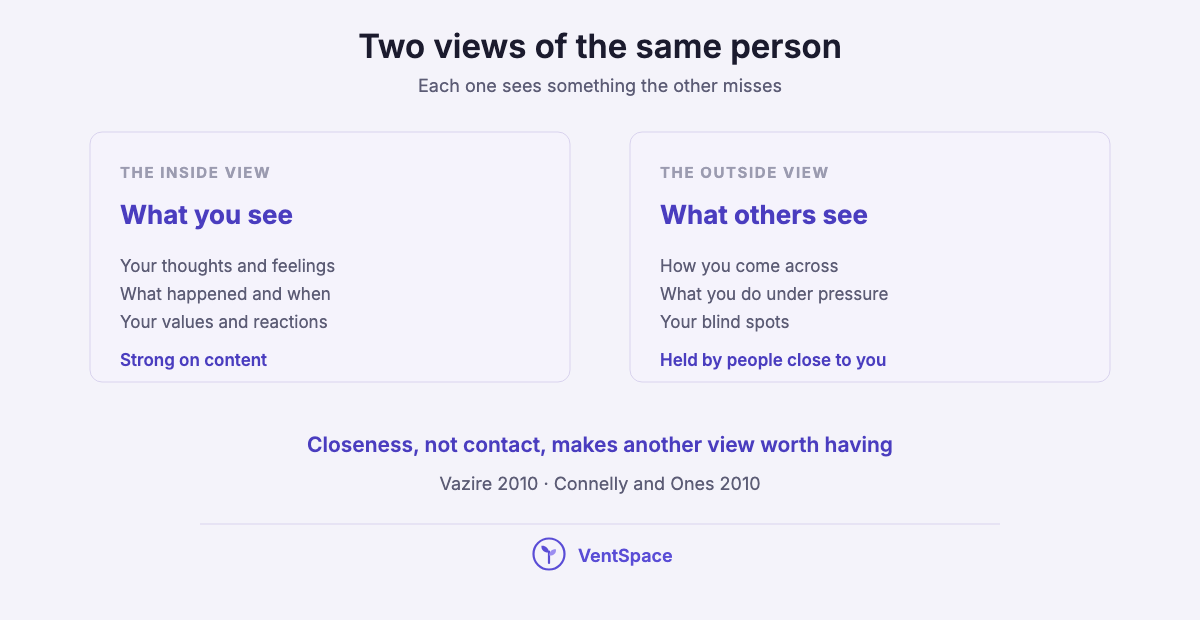
It comes in two views. The inside view of your own thoughts and values, and the outside view of how you come across. One research program found almost no link between them.
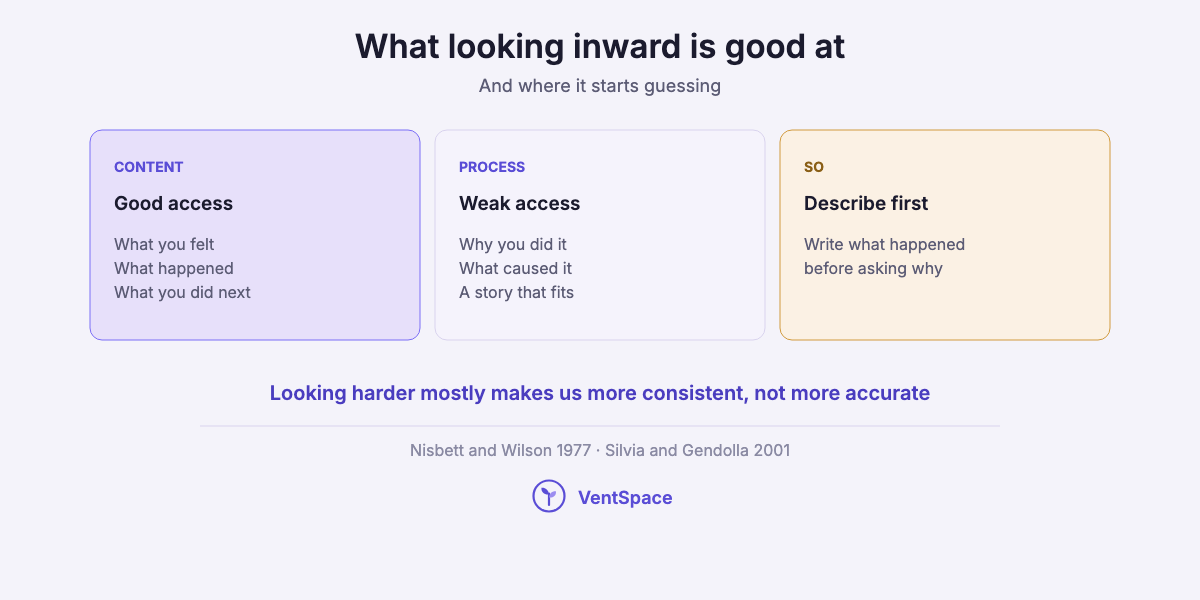
Looking harder does not reliably make you more accurate. We see the content of our lives well and the causes of our behavior poorly.
It has costs as well as benefits. Self-criticism and replaying are measurable parts of it.
Five steps, and one of them needs another person. Write what you want, rank what you need, describe before you explain, ask one person one question, and keep a record you read back.
What is self-awareness?
“It has become a popular “buzzword” in management literature, yet when reviewing this literature, there appears to be no consistent definition of the construct.” · Carden, Jones and Passmore, Journal of Management Education (2022)
Self-awareness is the capacity to become the object of your own attention, and to notice, process and store what you find about yourself. That is Morin’s definition, and it is a useful one because it is modest. It does not promise that what you find is true. It only says that you have turned the light round.
The idea has a specific origin. In 1972 the psychologists Shelley Duval and Robert Wicklund set out what they called objective self-awareness theory, the claim that attention can point outward at the world or inward at the self, and that when it points inward we start comparing ourselves with our own standards. Anyone who has caught sight of themselves in a store window and immediately stood up straighter has felt the theory at work. Three decades later, Paul Silvia and Duval himself reviewed the evidence and concluded that many of the original assumptions needed revision, particularly about what happens when we fall short of a standard and whether we try to close the gap or avoid looking. The core idea survived. The details are still being argued over.
That argument is worth knowing about, because it explains why the word feels slippery. When three researchers screened the management literature for a systematic review, they kept 31 articles and found that self-awareness, self-consciousness and self-knowledge were defined in overlapping ways. We are not confused because we have not thought hard enough. We are confused because the people who study it use the word differently, and the advice that reaches us inherits the muddle.
So it helps to separate three words that are often used as if they were one.
| Word | What it refers to | The everyday version |
|---|---|---|
| Self-awareness | The act or capacity of turning attention on yourself | “I notice I’m getting defensive” |
| Self-consciousness | In research, a habit of attending to yourself, private or public. In everyday speech, feeling watched and awkward | “Everyone can see I’m nervous” |
| Self-knowledge | What you have stored about yourself, accurate or not | “I’m someone who needs time alone after a party” |
The last row is where the trouble starts. Self-awareness is the looking. Self-knowledge is what the looking leaves behind, and nothing guarantees the two match. Much of this guide is about the gap between them.
Quick Summary
Q: What is self-awareness?
A: Self-awareness is the capacity to make yourself the object of your own attention, and to notice, process and store information about yourself. The idea goes back to Duval and Wicklund’s objective self-awareness theory (1972), and researchers still use the term in slightly different ways.
Insight: Alain Morin, reviewing the field in Social and Personality Psychology Compass (2011): “Main effects and functions of self-attention consist in self-evaluation, escape from the self, amplification of one’s subjective experience, increased self-knowledge, self-regulation, and inferences about others’ mental states (Theory-of-Mind).” Notice that escape from the self is on the list. Sometimes the attention is something we run from.
The kinds of self-awareness
“The bottom line is that self-awareness isn’t one truth. It’s a delicate balance of two distinct, even competing, viewpoints.” · Tasha Eurich, Harvard Business Review (2018)
There are three useful ways to divide self-awareness: private and public, internal and external, and reflection and insight. They overlap, and each one answers a different question about what we are doing when we look at ourselves.
Private and public. In 1975 Allan Fenigstein, Michael Scheier and Arnold Buss published a questionnaire that split self-consciousness into a private kind, attention to your own thoughts and feelings, and a public kind, attention to yourself as other people see you. The public kind is older than psychology. Writing in 1902, the sociologist Charles Horton Cooley called it the looking-glass self, and he noticed that the mirror is the wrong image for it, because what stings is not the reflection itself. In his words, “The thing that moves us to pride or shame is not the mere mechanical reflection of ourselves, but an imputed sentiment, the imagined effect of this reflection upon another’s mind.” We do not only see ourselves. We imagine being seen, and we feel the imagined verdict.
Internal and external. The most widely repeated version of this split comes from the organizational psychologist Tasha Eurich. In a 2018 Harvard Business Review article, she describes internal self-awareness as “how clearly we see our own values, passions, aspirations, fit with our environment, reactions (including thoughts, feelings, behaviors, strengths, and weaknesses), and impact on others”, and external self-awareness as “understanding how other people view us, in terms of those same factors.” Her team reports finding “virtually no relationship between them.” A provenance note belongs here, once. This comes from one research program, measured with an assessment her team built themselves, and reported in HBR and her 2017 book Insight. The article says the results were being written up for a journal, and we could not find a peer-reviewed paper as of October 2026. The split is useful. The peer-reviewed research below arrives at a similar place by a different road, which is the better reason to trust it.
Reflection and insight. This is the distinction the advice we usually read leaves out. In 2002 the psychologist Anthony Grant and his colleagues Franklin and Langford built the Self-Reflection and Insight Scale and found that examining yourself and understanding yourself are separate things. Self-reflection, the habit of looking, went with more anxiety and stress. Insight, the sense of understanding what you find, went with less depression, anxiety and stress, and with more flexible thinking. The measurements are correlational. They do not say looking causes anxiety. They do say that the amount of looking we do and the amount of understanding we get are not the same number.
It also helps to know that none of this arrives fully formed. The developmental psychologist Philippe Rochat described five levels of self-awareness unfolding from birth to roughly four or five years of age, and argued that adult self-awareness moves between those early levels rather than leaving them behind. We are all still, in some sense, working with the equipment we built as small children.
| Kind | The question it answers | Where it comes from |
|---|---|---|
| Private | What am I thinking and feeling? | Fenigstein, Scheier and Buss (1975) |
| Public | How do I look to others? | Fenigstein et al. (1975), and Cooley’s looking-glass self (1902) |
| Internal | How clearly do I see my values, reactions and impact? | Eurich (2018), practitioner research |
| External | How accurately do I know how others see me? | Eurich (2018), with the peer-reviewed self-other research below |
| Reflection | How much do I examine myself? | Grant, Franklin and Langford (2002) |
| Insight | How much do I understand what I find? | Grant, Franklin and Langford (2002) |
Quick Summary
Q: What are the types of self-awareness?
A: Self-awareness is usually divided into private and public (your inner states versus how you appear), internal and external (how you see yourself versus how others see you), and reflection and insight (how much you examine yourself versus how much you understand). These are different questions, and someone can be strong on one and weak on another.
Insight: Grant, Franklin and Langford, introducing the Self-Reflection and Insight Scale in Social Behavior and Personality (2002): “The SRIS-SR correlated positively with anxiety and stress, but not with depression and alexithymia. The SRIS-IN was negatively correlated with depression, anxiety, stress and alexithymia, and positively correlated with cognitive flexibility and self-regulation.” SR is the looking. IN is the understanding.
Why self-awareness matters, and how big the evidence is
“Research suggests that when we see ourselves clearly, we are more confident and more creative.” · Tasha Eurich, Harvard Business Review (2018)
Self-awareness matters because the way we see ourselves shapes our decisions, our work and our relationships, but the evidence for its benefits is more mixed in quality than the lists suggest. The sentence above is the most quoted line on the subject, and it headed a section of the first version of this page. It deserves to be read with its source in view.
Eurich’s article goes on to list what her team associates with seeing yourself clearly: sounder decisions, stronger relationships, better communication, more promotions, more effective leadership. She reports that internal self-awareness went with higher job and relationship satisfaction and with happiness, and that external self-awareness went with more empathy and perspective-taking. These are her program’s findings. They may well be right. They are also the findings of a team that built its own measure, and they have not, as far as we can find, been through peer review.
The same program produced the most repeated number on this subject. In Eurich’s own words, “even though most people believe they are self-aware, self-awareness is a truly rare quality: We estimate that only 10%–15% of the people we studied actually fit the criteria.” Three qualifiers travel with that figure every time. It describes the people her team studied, not humanity. It is measured against criteria her team created, a seven-factor assessment they developed because they found no existing measure strong enough. And it was reported in a magazine and a book, not a journal. You will often see it printed alongside a claim that 95% of people think they are self-aware. That second figure is not in the HBR article, and we have not read the book’s account of it, so we leave it out.
There is a quieter way to read the number, and it is the one we prefer. If the estimate is anywhere near right, most of us are not as self-aware as we feel, most of the time, for structural reasons rather than moral ones. It is not a verdict on anyone’s character. It describes how hard the task is.
And some of what we assume about the task turns out to be wrong. The common belief is that people flatter themselves, rating their own personalities more generously than others would. A 2019 meta-analysis by Kim, Di Domenico and Connelly pooled 152 samples and 33,033 people and found that, on average, how people described themselves did not differ from how people who knew them described them (average δ = −.038). The harsher ratings came from strangers. We are not, on the whole, deluded about ourselves.
What we lack is something more specific. A 2010 set of meta-analyses by Brian Connelly and Deniz Ones, across 263 samples and 44,178 people, found that ratings from other people predicted academic achievement and job performance better than people’s own ratings did, and added information the self-ratings missed. The condition was closeness. How often someone saw you helped their accuracy a little. How well they knew you was what made the large difference. And a pre-registered study of 238 people, published in 2022, found that people were at least moderately accurate about their own abilities in all six areas tested, with romantic partners about as accurate and partners and friends each adding something.
Put together, the honest summary is less dramatic than the headline and more useful. We see a good deal of ourselves accurately. We miss particular things. And the people who know us well can see some of what we miss.
Quick Summary
Q: Why is self-awareness important?
A: Practitioner research links self-awareness with better decisions, relationships and leadership, though that research has not been peer-reviewed. Peer-reviewed studies show that people are not generally self-flattering, but that the ratings of people who know you well add real information your own view lacks.
Insight: Brian Connelly and Deniz Ones, in a meta-analysis of 263 samples in Psychological Bulletin (2010), on what makes another person’s view of you worth having: “informants’ interpersonal intimacy with the target is necessary for substantial increases in other-rating accuracy.” And on what those views predict: “When the criterion was academic achievement or job performance, other-ratings yielded predictive validities substantially greater than and incremental to self-ratings.”
Why self-awareness is harder than it looks
“there may be little or no direct introspective access to higher order cognitive processes” · Richard Nisbett and Timothy Wilson, Psychological Review (1977)
Self-awareness is hard because we see the content of our lives clearly and the causes of our behavior poorly, and looking harder tends to confirm what we already believe. This is the mirror’s real limitation. You can see your face in it as long as you like. You will never see the back of your own head, however close you lean.
The foundational paper here is Richard Nisbett and Timothy Wilson’s 1977 review. They argued that when we explain why we did something, we are usually not reading off a record of the process. We are applying a plausible theory about what sort of thing causes that sort of response, and the theory may be right in general and wrong in our particular case. The paper is often summarized as “introspection doesn’t work”, which is not what it says. Its authors wrote that people “will sometimes be able to report accurately” about their own processes, and that our private access to the content of our lives can make us more accurate than an observer. We know what we felt and what happened. We are on weaker ground about why.
That distinction settles one of the most repeated rules in this genre, the advice to ask “what” instead of “why”. The rule is a useful default with the wrong explanation attached. A why about your own mental process (“why did I snap at her?”) tends to return a story that sounds true. A why about your history or circumstances (“why do Sunday evenings feel heavy for me?”) is answerable, because it rests on content you can check. And in a program of studies led by Ethan Kross, how far back people stood from an experience made more difference than which question word they used. It is the distance that matters, more than the word.
Looking harder from the same place has its own problem. In 2001 Paul Silvia and Guido Gendolla reviewed the evidence for the idea that self-focused attention makes us more accurate about ourselves, and concluded that it was unsupported. What self-focus did reliably increase was the motivation to stay consistent with how we already see ourselves. Most of us have had the experience. We set out to examine a habit honestly and come back, an hour later, with a more articulate defense of it.
Writing does not escape this, and it does not have to. Grant and his colleagues found that people who had kept diaries scored higher on self-reflection and lower on insight than people who had not. The study cannot say which came first. Perhaps people who are already turning things over are drawn to diaries. But it is a fair warning that a page filled every night is not the same as a page understood. And the problem is not the pen. On the questionnaire Treynor, Gonzalez and Nolen-Hoeksema used to separate brooding from reflection in a sample of 1,130 people, one of the reflection items is “Write down what you are thinking and analyze it.” We can brood on paper, and we can reflect on paper. What differs is whether the writing arrives somewhere.
Finally, we tend to underestimate how much we will change. Across six studies of more than 19,000 people aged 18 to 68, Jordi Quoidbach, Daniel Gilbert and Timothy Wilson found that people at every age believed they had changed a lot in the past decade and would change little in the next. The finding is disputed, partly because the studies compared different people rather than following the same ones. But it fits a feeling many of us know, that the person we are now is the finished version, when the evidence of our own past says otherwise.
Quick Summary
Q: Why is it hard to be self-aware?
A: We have good access to the content of our lives, what we felt and did, but weak access to the causes of our behavior, so our explanations are often plausible stories. Self-focused attention mainly makes us more consistent with how we already see ourselves, and examining yourself more does not automatically produce more insight.
Insight: Nisbett and Wilson, in the same 1977 paper, on what the inside view is good for: “the individual’s private access to content will sometimes allow him to be more accurate in his reports about the causes of his behavior than an observer would be.” And on where that advantage comes from: “Even these instances of superiority to observers, we would argue, are based not on access to process but access to content.”
The part nobody mentions: self-awareness can cost you
“this study highlights the need for awareness of the potential costs of developing self-awareness” · Anna Sutton, Europe’s Journal of Psychology (2016)
Self-awareness has real costs, including more self-criticism, guilt and replaying, and they are most likely when self-attention turns into rumination. Almost every page on this subject lists the benefits. Few mention that the measurement of self-awareness has a cost column too.
The occupational psychologist Anna Sutton built a questionnaire to measure what self-awareness does to people, starting from focus groups of therapists and testing it on 215 adults. Three of the four outcomes she found were benefits: reflective self-development, acceptance of yourself and others, and proactivity at work. The fourth was emotional costs, a set of items about guilt, fear and feeling vulnerable. Among the items her focus groups came up with were “I am more self-critical” and “I sometimes think ‘what have I been doing all these years?'” Anyone who has had a clear-eyed week about their own life will recognize the second one.
Who paid the costs was not random. In Sutton’s data, rumination predicted fewer benefits and more costs, while self-reflection and insight predicted benefits. The study was a single snapshot, so it cannot say what caused what. Eurich’s program reports something in the same direction, that people who introspect were less self-aware and reported worse job satisfaction and well-being, though again that is unpublished practitioner research. The pattern is consistent enough to say plainly. Turning the light on yourself can leave you clearer, or it can leave you circling, and from the inside the two feel almost the same.
None of this is a reason to stop looking. It is a reason to look in a particular way, briefly, concretely, and with a conclusion at the end, and to notice when the looking has become something else. If every attempt to understand yourself leaves you feeling worse for hours, or the same questions have been going round for weeks and are reaching your sleep, your work or the people close to you, that is worth taking to someone trained. Therapy is one option. For a lot of people it’s the right one. Our page on whether you need therapy walks through it without a checklist.
If you are struggling right now. If looking at your life has turned into feeling hopeless, or you are thinking about harming yourself, please contact a crisis line now. In the US, call or text 988 (Suicide & Crisis Lifeline). Anywhere else, findahelpline.com lists free, confidential services by country. This page is not a substitute for that.
Quick Summary
Q: Can self-awareness be bad for you?
A: It can have costs. In one study of 215 adults, self-awareness went with benefits such as self-development and acceptance, and also with emotional costs such as guilt and self-criticism. Rumination predicted more of the costs and fewer of the benefits.
Insight: Anna Sutton, summarizing what predicted the good and bad outcomes of self-awareness in her 2016 study: “self-reflection and insight predicted beneficial outcomes, rumination predicted reduced benefits and increased costs, and mindfulness predicted both increased proactivity and costs.” Even the practices sold as purely good showed up in both columns.
So what does it take to see more of the picture?
How to build self-awareness, in five steps
“the road to self-knowledge likely cannot be traveled alone but must be traveled with close others who can help shed light on our blind spots” · Bollich, Johannet and Vazire, Frontiers in Psychology (2011)
You build self-awareness by writing down what you want and need, describing your reactions before explaining them, asking one person who knows you well, and keeping a record you read back. The first three steps work the inside view. The fourth borrows the outside one. The fifth is what turns looking into understanding.
When Sai first wrote this page in 2022, he did the exercises alongside the reader and published his own answers. Those answers are kept below, lightly edited, because a worked example is worth more than a description of one. They are his, not a template. Yours will look nothing like them, and that is the point.
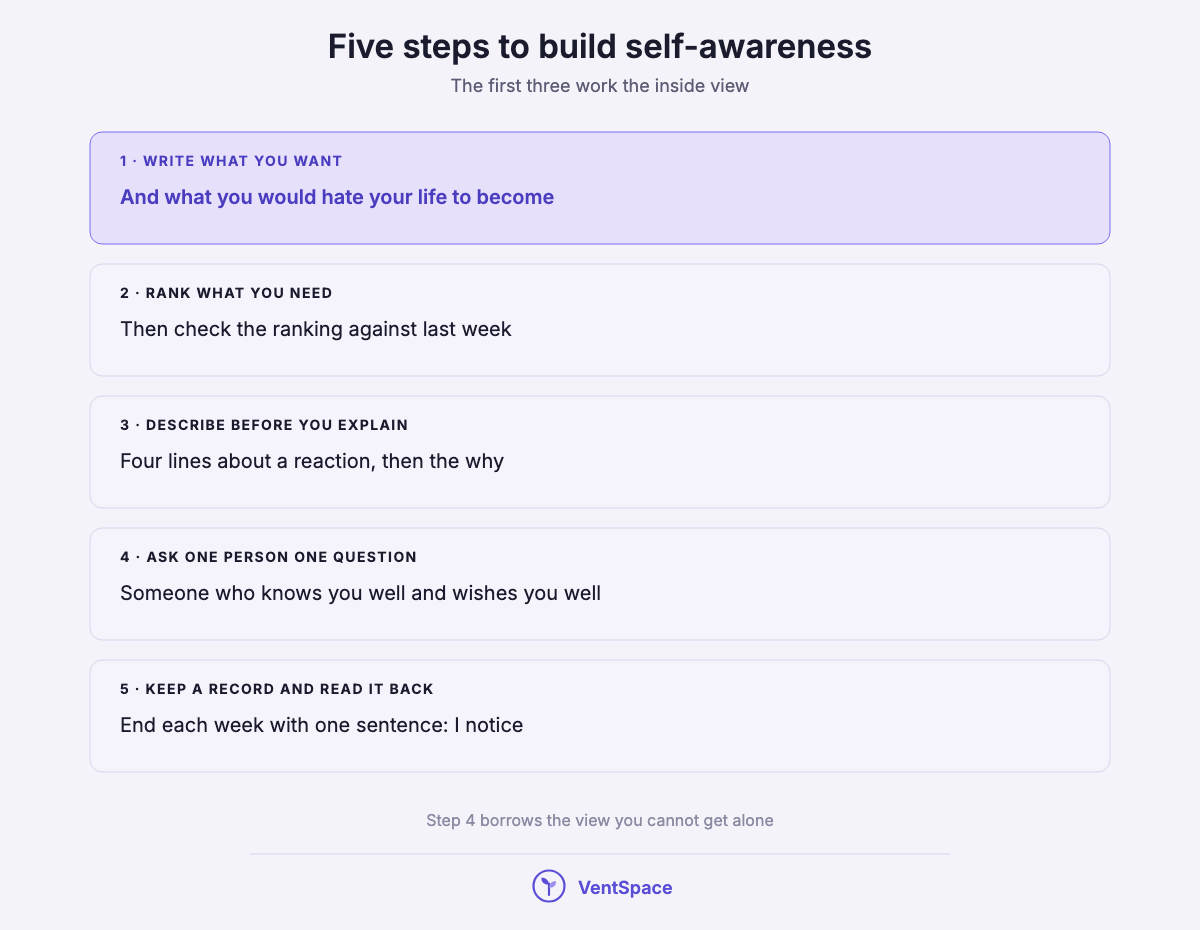
1. Write down what you want, and what you would hate your life to become
Start with two lists on one page: the life you want, and the life you would hate to end up in. Give the first list ten minutes and the second list five. The second list is usually shorter and more honest, because it is easier to know what we are running from than what we are running toward. Do not tidy either one. A list that sounds impressive is usually a list written for someone else.
Answer these in a line each:
- What kind of life do I want to be living in five years?
- What experiences and feelings do I want more of?
- If I had a week left, what would I spend it on?
- What would I hate my life to become?
- What am I most afraid of, and when did that fear start?
Be honest, no one is reading this but you.
From Sai, who writes this blog: my answers in 2022
What I want. I would love to make my life about traveling, to make travel my career, fill out my bucket list and experience a lot of things. I want to reach, serve and help a lot of people with my blogs, which gives me a sense of fulfillment. I want to fall in love again, be in a healthy relationship and maybe start a family. I want a healthy body, and to earn enough to provide for the people I love.
What matters to me, then. Travel, serving people, love, family and health. I want my life to be rich in all of these.
What I don’t want. To waste my life earning money in a job that doesn’t fit who I am inside. To spend my life alone, when I want to be surrounded by the people I love. To grow old and realize my life was empty. I don’t want regrets.
Notice what the worked example does. The wants are concrete enough to check against a calendar, and the “don’t want” list names fears in plain words. Neither list explains why. That comes later, and only partly.
2. Rank what you need right now
Take a short list of human needs and put it in order for your life as it is this year. Ranking forces a choice that a list of values never does, because everything on a values list sounds good. One list many people know is Tony Robbins’s “six human needs”: certainty, uncertainty or variety, significance, connection and love, growth, and contribution. It is a coaching framework, not a research finding, and nothing on this page depends on it being true. It is useful here only because it is short and the items pull against each other. Certainty and variety cannot both come first.
Write the six on a page and number them:
- Which of these would I give up last?
- Which one have I been feeding without meaning to?
- Where does my ranking disagree with how I spent last week?
- Has the order changed since five years ago?
Don’t overthink it. A rough order written in five minutes tells you more than a perfect one you never finish.
From Sai: my order in 2022
Love and connection, variety, growth, certainty, contribution, and significance.
What makes this useful is the third question. The ranking you write and the week you lived are two different accounts of the same person, and where they disagree is information, not failure. Our page on turning values into daily habits picks up from there, and our notes on Awaken the Giant Within cover more of Robbins’s thinking.
3. Describe a reaction before you explain it
When something sets you off this week, write down what happened and what you felt before you write a single word about why. This is the content-before-process rule from earlier, made physical. Content is what we are good at: who was there, what was said, what your body did, what you did next. Process is where we start inventing.
Take one recent moment and write four short lines:
- What happened, in the order it happened?
- What did I feel, and where in my body?
- What did I do or say next?
- Has something like this happened before, and when?
Only then, if you still want to, ask why. And if you do, try writing it as “you” or by your own name instead of “I”, the way you would describe what happened to someone whose side you are on. In Kross’s studies, people who used “you” or their own name instead of “I” while preparing for a socially stressful task showed less distress and less replaying afterward. Those studies were about social stress, and nothing in them says the answer becomes more accurate. What changes is how hot it feels to look.
There is no right answer here. The fourth question, about whether this has happened before, often turns out to be the useful one, because a repeated pattern is content you can see rather than a cause you have to guess.
4. Ask one person one narrow question
Choose one person who knows you well and wishes you well, and ask them one specific question about how you come across. This is the step that borrows the second mirror, and it is the one most of us skip, because it means hearing an answer we cannot control. The research gives it a precise shape. Closeness, not contact, is what makes another person’s view worth having. And the asymmetry runs both ways: in Simine Vazire’s 2010 study, people were the best judges of their own neuroticism-related traits, such as anxiety, while friends were the best judges of intellect-related ones. Ask about how you come across, not about what you feel. You already hold the better view of that.
Some questions that work, one at a time:
- What do I do when I’m under pressure that I might not notice?
- When have you seen me at my best this year?
- Is there something you think I avoid?
- How do I come across in the first five minutes of meeting someone?
Then listen, say thank you, and write the answer down without arguing with it. One reply is one view, not a verdict, and if it surprises you, it is worth checking quietly with a second person. Do not ask someone who is unkind to you, who has a stake in the answer, or whom you are currently fighting with. And if there is no one you could ask right now, a therapist can be one of the other people too.
Take your time with this one. It is fine to send the message tomorrow.
5. Keep a short record, and read it back
Write a few lines at the end of each day, and once a week read the week back and write one sentence about what you notice. The daily lines are the looking. The weekly sentence is where looking has a chance to become understanding, which is the part a diary on its own does not guarantee.
Sai’s version in 2022 was what he called a joy diary: at the end of each day, write down the things that made you happy or that you were grateful for. “Pay attention to the things that make you happy,” he wrote then. It is a gentle place to start, and it has a second use. Over a few weeks, a joy diary becomes a record of what fills your days with something good, which you can set beside the wants and the ranking from steps 1 and 2.
When you read a week back, ask:
- What came up more than once?
- What did I write about that I never mention to anyone?
- Where did my week disagree with my ranking?
- What would I tell a friend who had written this?
- What is one thing I will do differently next week?
If the reading back starts pulling you into replaying the whole story, stop for the night. Our page on journaling versus venting is about telling the two apart. The goal is a conclusion, however small, not a longer entry.
Quick Summary
Q: How can I improve my self-awareness?
A: Write down what you want and what you would hate your life to become, rank what you need, describe your reactions before explaining them, ask one person who knows you well one specific question, and keep a short record that you read back weekly and end with one conclusion.
Insight: Simine Vazire, in the 2010 Journal of Personality and Social Psychology study of 165 people rated by themselves, four friends and up to four strangers: “Consistent with SOKA model predictions, the self was the best judge of neuroticism-related traits, friends were the best judges of intellect-related traits, and people of all perspectives were equally good at judging extraversion-related traits.” Neither view wins outright. Each one sees something the other misses.
Pulling it all together
“People, it seems, regard the present as a watershed moment at which they have finally become the person they will be for the rest of their lives.” · Jordi Quoidbach, Daniel Gilbert and Timothy Wilson, Science (2013)
The five steps are one path, and they work best in order, over a few weeks rather than one evening. The quote above is a reminder of why it is worth repeating them. Whoever you find this month is not the final version, even if it feels that way, and the finding behind that sentence is itself still disputed.
Step 1 gives you a page of wants and fears in your own words. Tonight’s committed action: write both lists, and put the date at the top.
Step 2 turns the wants into an order you can check against your week. Committed action: number the six needs, then circle the one your last seven days disagree with.
Step 3 gives you one reaction described before it is explained. Committed action: the next time something sets you off, write the four lines before you write a “why”.
Step 4 brings in the view you cannot get alone. Committed action: write the name of one person and one question, and send it this week.
Step 5 turns the looking into a conclusion. Committed action: on the same evening each week, read the week back and write one sentence that starts “I notice”.
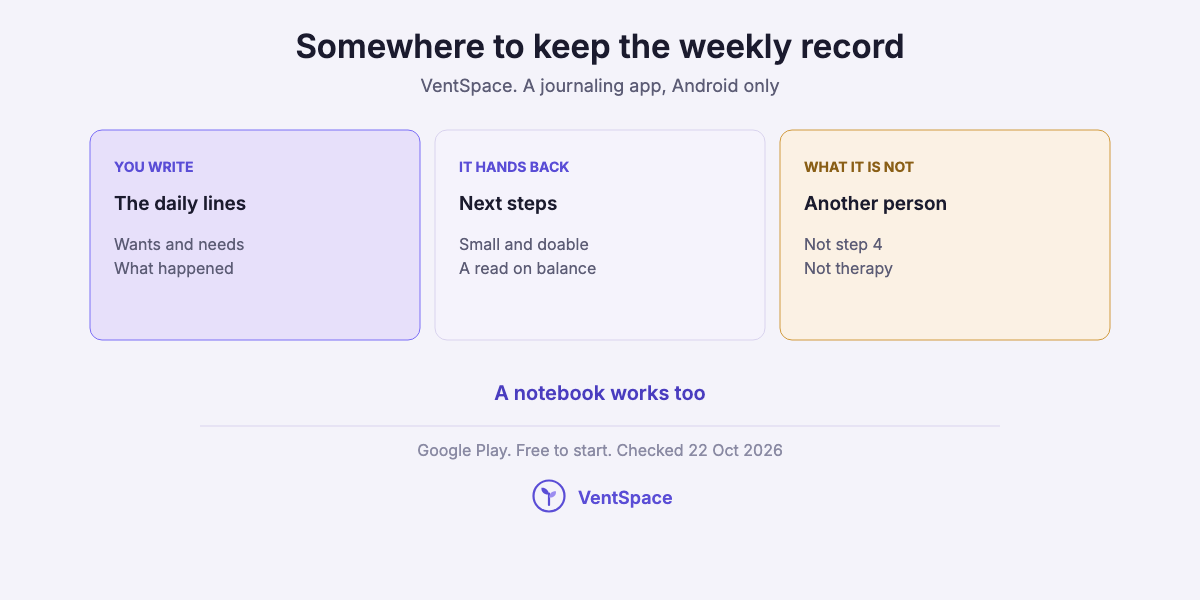
If you would like somewhere to keep that weekly record, VentSpace is a journaling app that turns what you write into a clear read on your life balance, plus small, doable next steps. It is free to start and Android only as of October 2026. Not on Android, or at a desk? VentSpace Live runs in your browser, free, with nothing to install. What it will not do is be the other person in step 4. It works the inside view, the half most of us already practice, and it is not therapy. A notebook works too.
Quick Summary
Q: What is the simplest way to start building self-awareness?
A: Tonight, write two lists, the life you want and the life you would hate to end up in, and date the page. This week, send one person who knows you well one specific question. Each week, read your notes back and write one sentence that starts “I notice”.
Insight: Ethan Kross and colleagues, summarizing seven studies of 585 people in the Journal of Personality and Social Psychology (2014): “small shifts in the language people use to refer to the self during introspection consequentially influence their ability to regulate their thoughts, feelings, and behavior under social stress”. Step 3 is that shift, used on an ordinary week.
Questions people ask about self-awareness
Do other people know you better than you know yourself?
Not overall, and the research that gets summarized this way says so itself. In Vazire’s study the self was the best judge of neuroticism-related traits, friends were better on intellect-related ones, and everyone did equally well on extraversion. A 2019 meta-analysis of 33,033 people found that self-descriptions did not, on average, differ from descriptions by people who knew them. Each view holds something the other lacks.
Can a self-awareness test tell me how self-aware I am?
Not on its own. A questionnaire that asks how well you know yourself is answered by the same view it is trying to check, so a high score mostly tells you that you rate yourself highly. That is our reasoning rather than a study, and it is why the outside view in step 4 matters. A quiz can still be a useful prompt for what to ask someone.
Can you be too self-aware?
You can spend too much time looking, and it can cost you. In Sutton’s study, the emotional costs of self-awareness, such as guilt and self-criticism, were most associated with rumination, and Grant’s research found that examining yourself more did not mean understanding yourself more. The answer is usually not less attention but shorter, more concrete attention that ends in a conclusion.
Is self-awareness the same as self-consciousness?
Not in everyday speech. Self-consciousness usually means feeling watched or awkward. In research, “self-consciousness” names a habit of paying attention to yourself, divided by Fenigstein, Scheier and Buss in 1975 into private and public kinds. Self-awareness is the broader capacity to turn attention on yourself at all.
Are we born self-aware?
Not fully. The developmental psychologist Philippe Rochat described five levels of self-awareness that unfold from birth to around four or five years of age, and he argued that adult self-awareness still moves between those early levels. It is something we grow into rather than switch on.
How long does it take to become more self-aware?
No study we found gives a timeline, and we will not invent one. Some of what you notice in step 3 can arrive in a week. The outside view in step 4 depends on someone else, and on your nerve more than your schedule. The habits of looking measured in this research gave closely matching scores when people were retested seven weeks later, which we read as a reason to be patient with yourself rather than a reason to give up.
In a nutshell
Self-awareness is not a trait you have or lack. It is a kind of attention, and like any attention it can be pointed well or badly.
Two things to take with you. First, you hold one of the two mirrors. You see the content of your own life better than anyone, and you see the back of your own head not at all, and the second view is held by people who know you well. Second, the honest timeline: nobody can tell you how long this takes. The scale Grant’s team built gave closely matching results when the same people took it seven weeks apart (test-retest .77 and .78), and our reading of that is simple: expect months of small, repeated looking rather than a breakthrough, and count the one sentence you write each week as progress.
Tonight, write the two lists from step 1. Who is the one person you would ask in step 4?
About this article

Written by
Sai Subramaniam
Founder, VentSpace
I write these guides because I have been where you are. I am working through my own hard seasons, and I share the things that actually helped me, so that anyone going through it has a steady companion close by instead of facing it alone. VentSpace is the app I built for exactly that: a journaling app that turns what you write into a clear read on your life balance, plus small, doable next steps toward feeling more like yourself.
This writing is honest and every claim is sourced, and it is not a substitute for professional care. If you are struggling, reaching out to a professional is a strong move, not a failure.
Explore VentSpaceTry VentSpace LiveHow this one was checked. Every factual claim traces to a named source, and the source is printed next to the claim rather than kept in a footnote. Quotes are pinned to the work they come from, with the year, the letter or the chapter where one exists. Where a widely repeated claim could not be traced, it was left out and the omission recorded. Where a figure is contested, both sides are printed.
No affiliate links, no paid placements, and nobody paid to appear here. Where we mention our own app, we say that it is ours, we state its limits, and we never position it as a substitute for care.
Reviewed: October 2026. Prices, platforms and product availability move quickly, and anything we could not verify at the time of writing is marked as unverified rather than turned into a number.
Corrections. If something here is wrong, we would rather know. Corrections are made in place, with a note saying what changed.