
Paid search buys the click today and stops the day the budget stops. SEO earns clicks you do not pay for one by one, and now citations in AI answers too, but only on queries with demand you can rank for, and only after months of work. Neither is the cheaper channel in general. Which one gets the money depends on the buyer: a consumer who searches and buys in one session, or a B2B buying group that researches for months before it talks to anyone.
So the split follows one law: pay for the queries where the searcher is choosing a provider now, and earn the queries where they are still learning. Paid search is good at the first and expensive at the second. SEO is slow at the first and is the only affordable way to show up for the second.
This page compares the two on the dimensions that decide a budget in 2026, then gives the decision rule by buyer type and budget, with separate sections for B2B lead generation and for consumer and Shopping accounts, because the answer flips between them.
How we know
Search data: Ahrefs’ study of 300,000 keywords (Feb 2026), Seer Interactive’s 42-client AI Overview data (Jun 2024 to Sep 2025), a 2026 randomized field experiment by Agarwal and Sen, and SparkToro’s Similarweb panel (Jan to Apr 2026). Each is named with its limits where used.
Platform rules: Google Search Central, Google Ads Help and the Microsoft Advertising blog, each checked on 29 October 2026.
First-party: accounts I ran, labelled where they appear. Each is one account, n=1.
What this cannot tell you: a cost per click or a click-through rate for your market. No “average CPC by industry” figure we found published its dataset, period and method, so there are none here. Your own Keyword Planner and Search Console data are the numbers to use.
The short version
Buy provider intent: queries where the searcher wants a vendor, a product or a price now.
Earn research intent: definitions, comparisons and how-to queries, where AI Overviews now take a large share of the clicks on both sides of the page.
B2B on a small budget: exact match on provider queries only, everything else to SEO, and judge paid on qualified leads in the CRM.
Consumer ecommerce with a feed: Shopping and Performance Max carry product queries, SEO carries category pages and guides.
Neither fixes a product nobody wants. Product-market fit decides more than the channel split.
What SEO buys you now
“Optimizing for generative AI search is optimizing for the search experience, and thus still SEO.”
Google Search Central, AI optimization guide, checked 29 October 2026
SEO is the work of making pages that rank in Google’s organic results and get cited in its AI answers, paid for in people and content rather than per click. Google’s documentation says there are no extra requirements or special markup to appear in AI Overviews or AI Mode: a page needs to be indexed and eligible for a snippet, as its AI features page explains. Our guide to generative engine optimization covers that side in full.
What you get is a position on queries you do not pay for each time someone clicks. What you give up is speed and control: Google picks which query a page shows for and how its title reads, and a new page on a competitive query can take months to rank, or never rank.
What paid search buys you now
Paid search is an auction for a place in the ads above and around the results, paid per click, that serves the day you switch it on and stops the day you switch it off. On Google that means Search campaigns, Shopping, and Performance Max, which runs across Search, Shopping, YouTube and Google’s other inventory from one budget.
What you get is speed and a choice of query. What you give up is cost per click forever, and less control over matching than the keyword list suggests: broad match uses the searcher’s recent searches and your landing page, and AI Max adds keywordless matching to Search campaigns (Google Ads Help, both checked 29 October 2026). Our performance marketing fundamentals explain how a campaign is built.
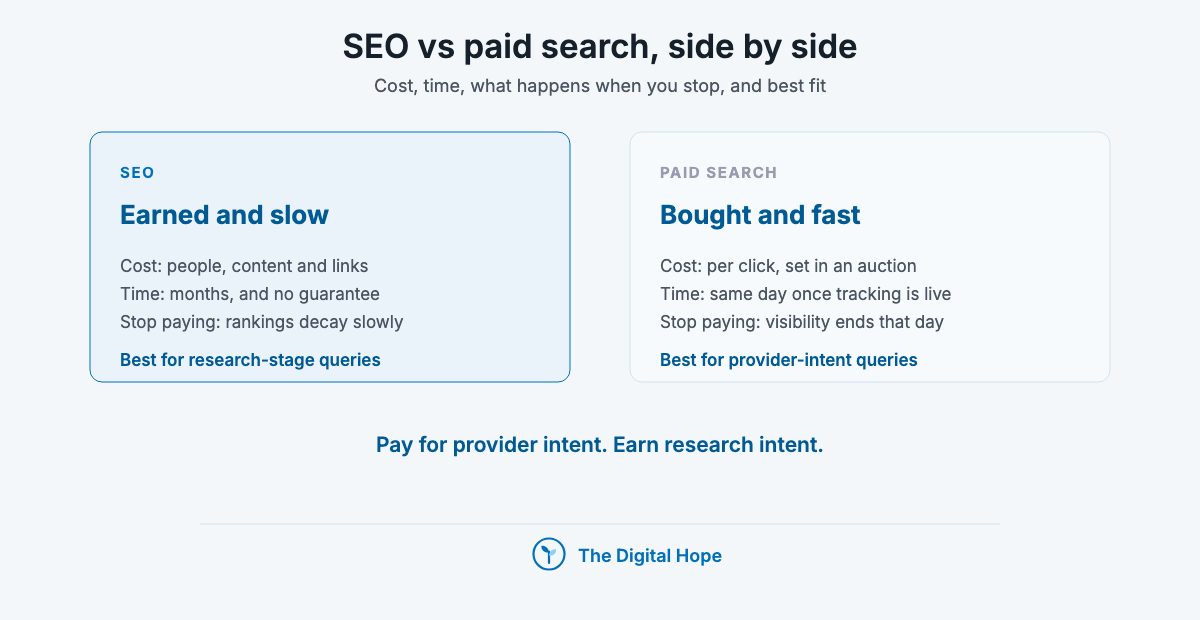
SEO vs paid search, side by side
| Dimension | SEO | Paid search |
|---|---|---|
| Cost model | People, content and links. No per-click cost | Per click, set in an auction. Stops when the budget stops |
| Time to first result | Months for a new page on a competitive query, and no guarantee | Same day, once the account and tracking are live |
| When you stop paying | Rankings decay slowly as pages age and competitors publish | Visibility ends that day |
| Control over the query | Low. Google picks the query and often rewrites the title | High on exact match, falling as broad match, AI Max and Performance Max widen matching |
| What AI answers do to it | Fewer clicks on informational queries. Citations become a second prize | Less studied. On informational queries, cited brands also kept more paid clicks in one dataset |
| Measurement | Search Console counts AI impressions but not AI clicks. Some AI visits land in GA4 as Direct | The platform reports its own results, counting the conversion you send it |
| Best fit | Research-stage queries, category pages, anything with steady demand | Provider-intent queries, products with a feed, new offers, testing which queries convert |
AI answers took clicks from informational queries on both sides of the page
On informational queries, an AI Overview now answers above both the ads and the organic results, and the click studies agree that fewer people click anything. On transactional queries, the effect is much smaller. That is the single biggest change to this comparison since 2024.
The same direction shows up in every dataset that measured it:
- Ahrefs’ study of 300,000 keywords (Feb 2026, desktop Search Console data) associated an AI Overview with a roughly 58% lower click-through rate for the top-ranking page in December 2025 against a forecast. Correlational, and Ahrefs sells AI Overview tracking.
- A randomized field experiment by Agarwal and Sen (revised 2026, not yet peer reviewed) found AI Overviews cut organic clicks by 39.8%, appearing on about 53% of informational queries, with no measurable change on navigational and transactional queries.
- SparkToro’s Similarweb data put US zero-click Google searches at 68.01% in January to April 2026, up from 60.45% in 2024, with the caveat that the two years use different panels.
- Seer Interactive’s data across 42 clients (Jun 2024 to Sep 2025, 3,119 informational queries) found organic CTR of 1.45% with no AI Overview, 0.70% when the brand was cited and 0.52% when it was not. Brands cited in the Overview also kept more paid clicks. Seer notes citation may track brand strength rather than cause the difference.
AI Mode is a third surface on top of both. Google said in May 2026 that AI Mode had passed one billion monthly users, while SparkToro measured only 0.34% of US searches reaching it in early 2026. Usage counts and share of searches are different measures, so treat AI Mode as small in volume and growing.
My read: a research query is now worth less as a click to either channel, and more as a citation. That pushes research intent further toward SEO, which earns the citation, and away from paid, which buys a click fewer people make.
Informational clicks shrank on both sides.
Quick Summary: do AI Overviews affect SEO and paid search differently?
Q: Do AI Overviews hurt SEO more than paid search?
A: On informational queries they reduce clicks to organic results sharply, by about 40% in a 2026 randomized experiment, and the effect on transactional queries was not measurable. Paid clicks on AI Overview queries are less studied, but in Seer’s client data brands cited in the Overview kept more of both kinds of click.
Insight: Google counts AI traffic but not AI clicks separately
Search Console’s generative AI performance report, rolled out to every property by 31 August 2026 (Google Search Central blog), shows how often your pages appeared in AI features, not how many clicks came from them. AI feature clicks are counted inside the ordinary Web search type, so a falling organic click line can hide a rising citation line.
Paid stops on the day the budget stops, and organic decays more slowly than people expect
Paid visibility ends the hour the budget runs out. Organic visibility fades over months as pages age, competitors publish and branded demand moves, so SEO is a slower decay, not an autopilot. The comparison most budget owners make, “paid is rented, SEO is owned”, is half right.
What decay looks like in practice:
- Paid: a campaign paused on Friday serves no ads on Saturday. Any brand recall it built is the only thing left.
- Organic: a page that ranked in 2024 slips as newer, more specific pages publish on the same query, and as AI Overviews take clicks from the queries it ranks for.
- AI citations: Ahrefs’ March 2026 data found that most pages cited in AI Overviews did not rank in the top 10 for that exact query, so a citation is a separate position you can gain or lose.
- And in one B2B account I ran (Forage AI, web data for AI, March to October 2026), US non-branded clicks in Search Console tripled from 51 to 151 per four weeks, while total clicks stayed flat at 927 to 919 because branded search fell, and impressions dropped from 208K to 132K as older posts decayed. One site, one period: [FIRST-PARTY, n=1].
That last line is the honest version of “SEO compounds”. The growth was real and the decay was real in the same weeks. An SEO budget pays for new pages and for upkeep on old ones, and our SEO audit checklist is where the upkeep starts.
SEO is owned, with maintenance.
Quick Summary: is SEO cheaper than paid search in the long run?
Q: Does SEO keep working after you stop paying for it?
A: Rankings fade slowly rather than stopping, so traffic continues for a while, but pages decay as they age and competitors publish. Paid search stops the day the budget stops. The long-run cost of SEO is new content plus upkeep, not zero.
Insight: branded and non-branded traffic move in different directions
In the same Forage AI data, the headline organic number hid two opposite trends: branded clicks fell while non-branded clicks tripled. A report that shows only total organic clicks would have called a working programme flat. Split branded from non-branded before you judge either channel.
Control: paid lets you choose the query, but less than the keyword list suggests
“There are no additional requirements to appear in AI Overviews or AI Mode, nor other special optimizations necessary.”
Google Search Central, AI features and your website, checked 29 October 2026
Paid search still gives you more control over which queries you appear on than SEO, but every Google automation launched since 2021 widens matching, so the control now has to be set, not assumed. On the SEO side you choose the topic and Google chooses the query, which has not changed.
Four documented mechanics decide how much control paid gives you:
- Broad match uses the searcher’s recent searches, your landing page and other keywords in the ad group, and Google calls Smart Bidding “critical” with it (Google Ads Help, answer 7478529, checked 29 October 2026).
- AI Max for Search adds keywordless matching, ad text customisation and final URL expansion, and its controls are brand lists, URL exclusions and locations of interest, as Google’s AI Max page lists.
- Performance Max search themes rank with phrase and broad keywords, and only an exact keyword identical to the query takes priority over them (Google Ads Help, answer 14179631).
- Microsoft Advertising turned AI Max on by default for new Search campaigns on 27 August 2026 (Microsoft Advertising blog).
On a small budget, every widened match spends money on queries you did not choose. On a large consumer account with conversion volume, the same widening can find demand a keyword list misses. Same mechanics, different verdict by volume.
Control is now a setting.
Quick Summary: which gives more control, SEO or PPC?
Q: Can you control which searches your ads show for?
A: Yes on exact match, less on broad match, AI Max and Performance Max, which match beyond your keyword list by design. In SEO you choose the topic and the page, and Google chooses the queries it ranks for.
Insight: one platform published its test design
Microsoft’s AI Max launch post (27 August 2026) reported 44 advertiser A/B experiments, 10 of them significant and positive, with a lower-bound uplift of about 8% in conversions. It measured conversions, not lead quality, and 34 of 44 experiments were not significant positives. That is the evidence base for “automation finds more demand”: real, platform-run, and silent on lead quality.
The decision rule: split by buyer type first, then by budget
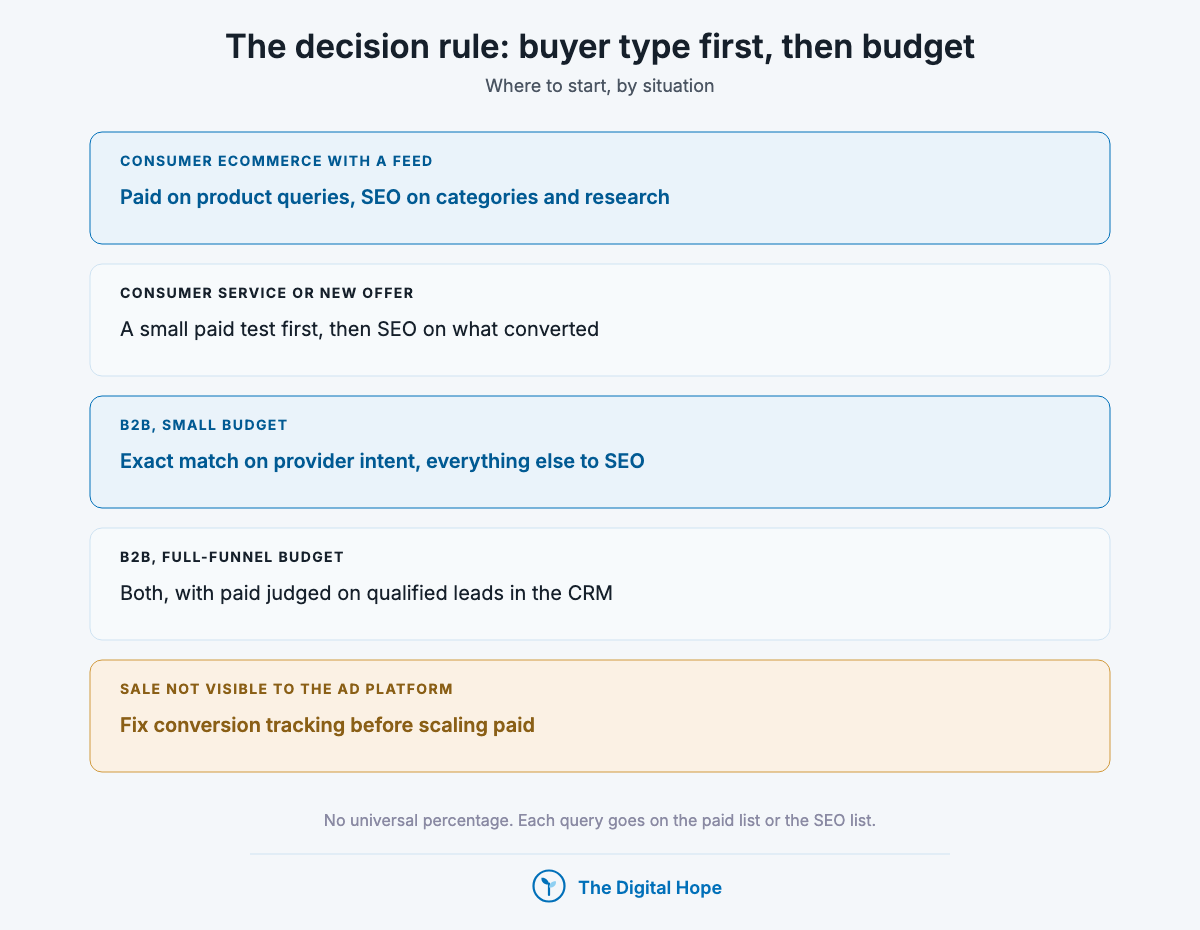
Decide the split by asking where your buyer is when they search, then how much paid volume your budget can buy. There is no universal percentage. A small B2B account and a large consumer retailer get opposite answers to the same question.
| Your situation | Paid search does | SEO does | Where to start |
|---|---|---|---|
| Consumer ecommerce with a product feed and steady online sales | Shopping and Performance Max carry product queries | Category pages, product pages and buying guides | Paid on product queries, SEO on categories and research |
| Consumer service or new offer, no sales history | Shows within days which queries convert | Builds slowly on the queries paid proved | A small paid test first, then SEO on what converted |
| B2B, small budget (a few hundred clicks a month or fewer) | Exact match on provider-intent queries only | Definitions, comparisons, how-to and category pages | Paid on provider intent, everything else to SEO |
| B2B with budget for a full funnel | Top, middle and bottom of funnel feeding each other, plus retargeting | Research content that fills the retargeting pools | Both, with paid judged on qualified leads |
| Any buyer, sale not visible to the ad platform | Bids on whatever event it can see | Unaffected | Fix conversion tracking before scaling paid |
Run these questions on your own account before you set the split:
- Does the buyer decide in one session, or over weeks with several people?
- How many of your target queries name a product, a vendor, a price or “near me”?
- At your cost per click, how many clicks does a month of budget buy? If it is a few hundred, paid can cover only the narrowest queries.
- Can the ad platform see the sale or the qualified lead, or only a click or a form fill?
- Do you already rank in the top three for any query you are paying for?
- Is there search demand at all? A new category with no searches needs neither channel yet.
A mixed result is the common case. Most businesses have a few provider-intent queries worth buying and a long list of research queries worth earning. The rule is which list each query goes on.
Buyer first, budget second.
Quick Summary: SEO vs paid search decision rule
Q: How should I split my budget between SEO and paid search?
A: Pay for queries where the searcher is choosing a provider or product now, and put research queries into SEO. Consumer ecommerce with a feed leans on Shopping and Performance Max for products. B2B on a small budget buys only provider-intent queries on exact match.
Insight: the buyer's timeline outlasts any ad platform's window
Dreamdata’s 2026 LinkedIn benchmarks, built on 3.5 million B2B customer journeys mostly from software companies, put the average at about 281 days from a first LinkedIn ad impression to revenue. Dreamdata sells attribution and does not publish its model, so treat it as direction. A research-stage searcher in B2B may not buy for most of a year, which is why that stage is cheaper to earn than to buy.
B2B: buy provider intent, earn research intent, and fund a full funnel
“Should have at least 15 conversions in the last 30 days.”
Google Ads Help, “Best practices for generating high-quality leads”, on the conversion action used for lead-quality bidding, checked 29 October 2026
In B2B lead generation, paid search should buy the queries where someone is looking for a provider, and SEO should own the definitions and category terms, because a small budget cannot pay for months of research clicks. The click math decides it before any strategy does.
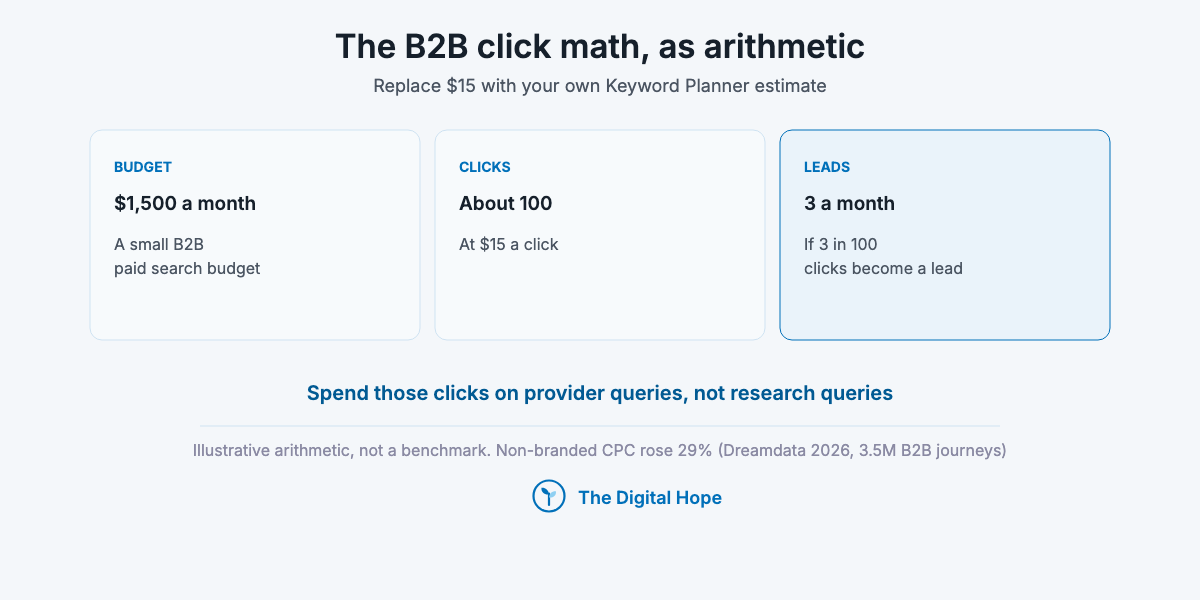
The click math, as arithmetic rather than a benchmark: at $15 a click (replace it with your own Keyword Planner estimate), $1,500 a month buys about 100 clicks. If 3 in 100 become a lead, that is 3 leads a month. Spend those 100 clicks on “what is” queries and most of them go to people who are not buying this year. Non-branded Google search CPC rose 29% in Dreamdata’s 2026 benchmarks (3.5 million B2B journeys, mostly software companies), so research clicks are getting dearer, not cheaper.
How I sort B2B queries before any money moves, a working method, not a platform rule:
- Launch: the searcher names the service, a vendor type or a buying action (“web scraping service”, “data provider for AI”). Exact match.
- Test: close to buying but ambiguous. A capped budget and a kill date.
- Hold: research and category heads. Leave to SEO.
- Negative: jobs, free, tutorials, students, and any query that has spent your target cost per lead with no conversion.
Organic rank is an input to that list. I keep a Search Console column of current organic position next to every candidate keyword. A provider query where you already hold a top-three organic position goes to Test, not Launch, so you can see whether the ad adds clicks or just takes them from your own listing.
Three settings that matter on a low-volume B2B account:
- Match type: under roughly 30 qualified conversions a month, start exact, with broad and AI Max off, and treat them as an experiment to earn. That is our position, not a platform rule. In Optmyzr’s analysis of 2023 data from accounts running both, exact had the better ROAS in about 74% of them, before AI Max existed.
- Performance Max: for low-volume B2B lead generation, avoid it. It needs conversion volume these accounts do not have, and it spends across inventory a buyer committee does not search.
- The goal you bid on: bid toward the deepest stage that clears Google’s floor of about 15 conversions in 30 days, as its lead-quality guidance sets out, and reconcile every platform lead count with the CRM. One B2B AI Max test reported in Search Engine Land (August 2026) cut CPC 59% while cost per lead rose from $493 to $850. Its method was not published.
A bottom-of-funnel keyword list on its own is not a B2B strategy. Those terms barely have volume, and they skip the stage where a buying group vets vendors. With budget, B2B paid works as a full funnel: video and content at the top, retargeting in the middle fed by site visitors and conversion data, and provider-intent search plus content-download audiences at the bottom. Below that budget, provider-intent search plus retargeting is the floor.
And in one B2B account I ran (Forage AI, $1,500 a month, 2026), people searching for a service provider engaged at 62% in GA4 against 18% for the category’s head term. Engagement is not pipeline, and pipeline from that account is not in yet: [FIRST-PARTY, n=1].
Buy the shortlist, earn the research.
Quick Summary: SEO or Google Ads for B2B
Q: Should a B2B company spend on SEO or Google Ads?
A: On a small budget, Google Ads on exact-match provider queries and SEO for everything earlier in the journey. With budget for a full funnel, run both, and judge paid on qualified leads in the CRM rather than platform form fills.
Insight: the "5% in market" figure is a heuristic, not a measurement
The 95:5 rule comes from Ehrenberg-Bass researcher John Dawes, who derived it from an assumed five-year switching cycle and writes that “the 95% figure is not meant to be a precise rule.” Forrester’s survey of martech buyers (May 2025) put the in-market share nearer 15% to 30%, varying by category. Either way most of a B2B market is not buying this quarter, which is the case for earning research intent rather than buying it.
Consumer and Shopping: let the feed and the conversion volume decide
For consumer ecommerce with a product feed and steady online sales, Shopping and Performance Max should carry the product queries, and SEO should carry category pages and the research before the purchase. This is the opposite of the B2B verdict on Performance Max, and the difference is volume: a retailer sends the system enough purchases to learn from.
What changed that makes Performance Max a legitimate core campaign for retail:
- It no longer automatically wins over Standard Shopping. Since October 2024, when both campaigns hold the same products, the one with the higher Ad Rank serves, as Google told advertisers in a notice reported by Search Engine Roundtable. Standard Shopping can now run beside it as a real comparison.
- It has negatives and search terms. Since 2025, Performance Max accepts campaign-level negative keyword lists and shows search terms for every campaign, with up to 50 search themes per asset group, as Google’s Performance Max update page lists (7 August 2025).
- Smart Shopping no longer exists. Google began upgrading it into Performance Max in July 2022.
Two things to decide on purpose rather than accept:
- Your brand name. In Haus’ geo tests of Performance Max with and without brand terms (August 2024, number of tests not stated), excluding brand won half the time but averaged 24% more incremental revenue and was more efficient on new customers. For orders above about $238, including brand did better. The data is two years old, so use it as a reason to test, not a setting.
- A comparison campaign. Optmyzr’s 2024 study of about 25,000 Performance Max campaigns found most advertisers run it beside Search and Shopping, and that the siloed campaigns usually won where they competed. Observational, from 2024, and past its useful date as a benchmark.
Where this does not hold: a consumer business with no feed, few online conversions, or sales that complete somewhere the ad platform cannot see. There, Performance Max has little to learn from, and Search on product and “near me” queries plus SEO on service pages is the safer split.
Feed plus volume earns automation.
Quick Summary: Performance Max vs SEO for ecommerce
Q: Should an online store use Performance Max or SEO?
A: Both, for different queries. Shopping and Performance Max carry product queries when you have a feed and steady online sales. SEO carries category pages and buying guides. Keep Standard Shopping or Search as a comparison, and decide brand terms with a test.
Insight: the platform can only bid on the sale it can see
Performance Max learns from the conversions you send it. If purchases complete on a third-party checkout or ticketing site with no conversion tag, the system learns from clicks instead, and its reported results cannot be read as sales. Check that the purchase event fires before you let any automated campaign set the budget.
Where the line blurs: each channel feeds the other
SEO and paid search share one results page and one buyer, so the best split uses each to make the other cheaper. Treating them as rival budgets misses most of the value.
Four ways they feed each other:
- Search terms feed content. The paid search terms report shows the exact phrasing of people who clicked and converted. Those are the queries worth building pages for.
- Organic rank feeds keyword choice. Where you rank in the top three, test whether the ad adds clicks before you keep paying for it.
- Content feeds retargeting. Research-stage visitors who arrive through SEO become the audience paid can reach later, at the provider-intent stage.
- And in one B2B account I ran (Clarifai, AI infrastructure, July 2025 to May 2026), the account had been buying only bottom-of-funnel commercial terms with almost no volume. Rebuilt as a full funnel across Google Search, Video, Demand Gen, LinkedIn, Reddit and X, with the developer community treated as a brand asset, cost per signup went from about $1,000 to under $4, with sales-accepted leads at about $25 to $30. It was a free self-serve signup and one account: [FIRST-PARTY, n=1].
My read: product-market fit decided more than the channel mix. I ran the same Demand Gen format at two companies with different results, and the difference was the product, not the setup.
One page, one buyer, two budgets.
Quick Summary: SEO and PPC together
Q: Should SEO and PPC work together?
A: Yes, through three handoffs: paid search terms show which queries to build pages for, organic rank shows which paid keywords to test pausing, and SEO visitors become the retargeting audience for paid.
Insight: our ads playbook covers the paid side week to week
Once the split is set, the paid half needs a cadence: which metric points at which fix and when to leave the account alone. Our ads optimization playbook covers that, and our page on whether SEO is worth it covers the organic business case.
What stopped being true
| What | When | Primary source |
|---|---|---|
| Broad match modifier as its own match type | Folded into phrase match, February to July 2021 | Google Ads Help, answer 10286719 |
| Smart Shopping campaigns | Upgraded into Performance Max from July 2022 | Google Ads Developer Blog, 22 July 2022 |
| Organic results as the first answer on Google for everyone in the US | AI Overviews rolled out to all US users, 14 May 2024 | Google, The Keyword, May 2024 |
| Performance Max automatically outranking Standard Shopping | Higher Ad Rank serves, from October 2024 | Google advertiser notice, reported by Search Engine Roundtable, 22 October 2024 |
| Performance Max with no negative keywords and no search terms | Campaign-level negative lists and search terms for all campaigns, 2025 | Google Ads Help, answer 16451273, 7 August 2025 |
| Search campaigns that match only listed keywords | AI Max adds keywordless matching, announced May 2025 | Google Ads Help, answer 15910187 |
| Microsoft Search campaigns with automation off unless chosen | AI Max on by default for new Search campaigns, 27 August 2026 | Microsoft Advertising blog, 27 August 2026 |
| Dynamic Search Ads as a standalone option | Automatic upgrade to AI Max from February 2027 | Google Ads Help, answer 2471185 |
Questions people ask about SEO vs paid search
Is SEO cheaper than paid search?
Per click, yes, because there is no auction. Per result, not necessarily. SEO costs writers, editors, links and upkeep, and pays back only on queries you can rank for. Compare cost per qualified visit over a year, not cost per click.
Should a startup start with SEO or Google Ads?
Start with a small paid test if the product is bought on search, then build SEO on the queries that converted. Paid answers which queries convert within weeks. If nobody searches for the category yet, neither channel will create the demand.
Should I bid on keywords I already rank first for?
Test it rather than assume. Pause the ad for a period or a region and compare total clicks from both channels in Search Console and Google Ads. The closest controlled evidence we found is consumer and about Performance Max brand terms, where excluding brand won half the time.
Is it true that only 5% of B2B buyers are in market?
No, that is a heuristic. John Dawes derived it from an assumed five-year buying cycle and says it is not precise, and Forrester’s survey put martech in-market share at 15% to 30%. Your category’s buying cycle sets your real number.
Do AI Overviews affect paid search?
Less is published on the paid side. In Seer’s 2024 to 2025 client data, brands cited in an AI Overview kept more organic and more paid clicks than brands that were not, though the study cannot show the citation caused it.
In a nutshell
Paid search answers in weeks, SEO in months, and SEO keeps needing upkeep after it works. Plan the paid half with a review date a month out and the SEO half with a review date two or three quarters out, and expect some pages never to rank.
This split holds where your buyer searches before buying and the ad platform can see the sale or the qualified lead. If tracking is broken, fix it before moving money, and if nobody searches for the category, neither channel is the answer yet. Google adding AI Overview clicks to Search Console, or ads inside AI Mode at scale, is what would change this call.
If you would rather have someone look at your account and the split, that is what I do in a consultation.
About this article

Written by
Sai Subramaniam
SEO, GEO and Paid Ads Manager · 8+ years in growth marketing
I have run SEO, paid media and ABM for B2B AI companies, consumer apps and live-entertainment brands, from a solo operator at an AI infrastructure company to a team of 20 recovering a million-visitor site after a Google update. I write these guides from that work, and every number in them carries its source.
See my portfolioConnect on LinkedInHow this one was checked. Every number traces to a named source with its dataset and period, and every platform feature, policy or limit cites the platform’s own documentation with the date it was verified. Where the author’s own results appear, they are labelled as one account’s results, with the budget and context, not as a rule.
No affiliate links and no paid placements. Tools are named because they are what practitioners use, not because anyone paid to appear here.
Reviewed: October 2026. Ad platforms and search features change every few months; anything we could not verify at the time of writing is marked as unverified rather than turned into a number.
Corrections. If something here is wrong or has changed since, we would rather know. Corrections are made in place, with a note saying what changed.